
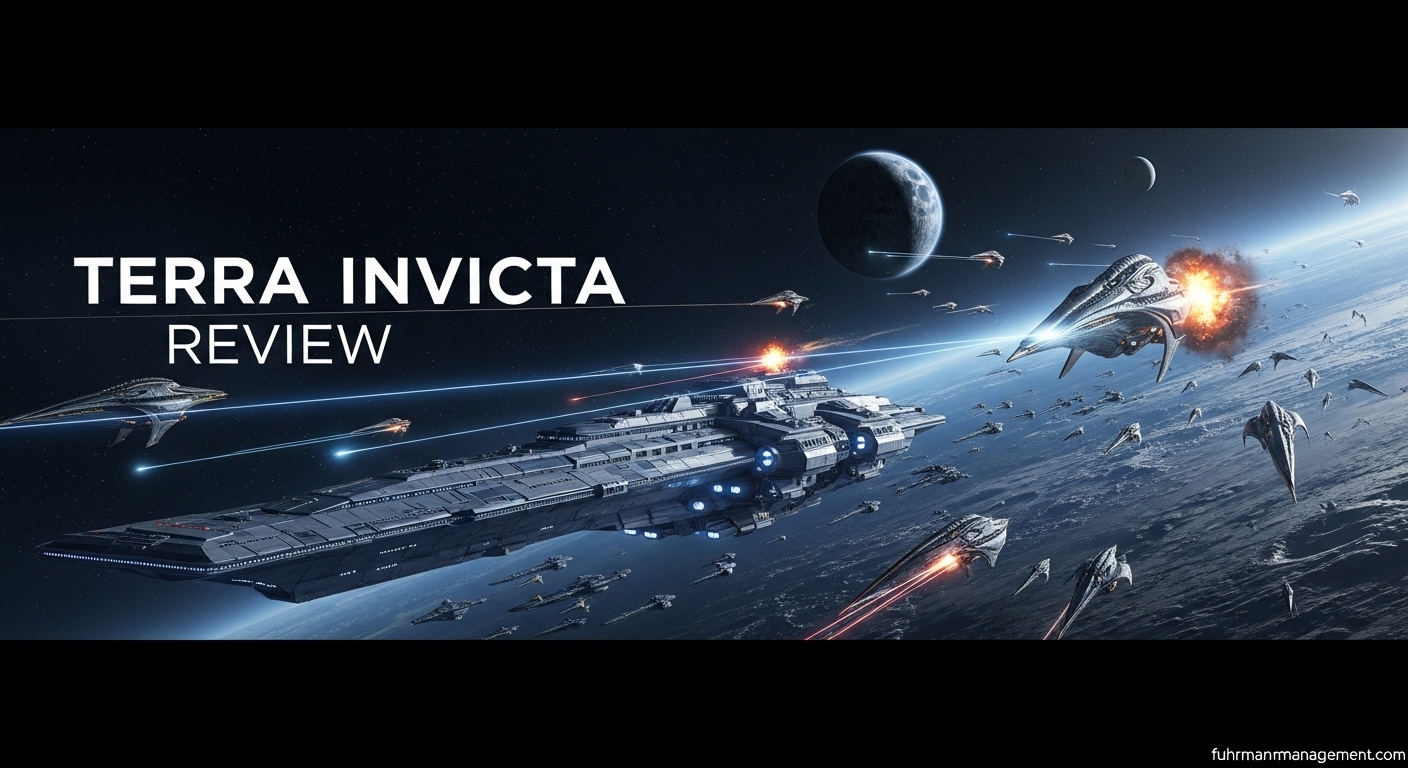
When an alien ship crashes into the moon and releases the seeds of a slow-motion invasion, humanity doesn’t immediately unite. Instead, it fractures. This is the chilling, brilliant premise of Terra Invicta, a game that dares to ask: What would actually happen if we faced an existential threat from the stars? In this Terra Invicta review, we’ll dive deep into a title that blends the geopolitical tension of Hearts of Iron with the tactical squad management of X-Com, all wrapped in a realistic orbital simulation.
Developed by the creators of the long-standing X-Com mod, The Long War, this game was never going to be a casual walk in the park. It is dense, uncompromising, and occasionally frustrating. But for those who crave a strategy game that respects their intelligence and demands mastery of systems ranging from global economics to delta-v calculations, Terra Invicta is a singular achievement. It stands as one of the most ambitious 4X/grand strategy hybrids in recent memory.
A Fractured Humanity: The Factions
The game begins with a choice that defines your entire playstyle. You don’t play as “Humanity”; you play as a specific faction vying for control of Earth’s response to the aliens.
There are seven main factions, ranging from the Resistance (classic defenders of freedom) to the Academy (scientists who want to understand the aliens) and the Servants (cultists who worship the invaders). There are even factions like the Project Exodus who want to flee Earth, and the Humanity First who advocate for aggressive xenocide.
This political layer is the game’s first major hurdle. You aren’t given armies to command immediately. Instead, you start with a handful of councilors—spies, executives, and soldiers—who must be sent to nations to increase influence. You have to seize control of regions, coup governments that oppose you, and manage the global economy to fund your eventual war machine. It’s a game of shadow wars and political maneuvering long before the first spaceship is built.
If you enjoy grand strategy titles that focus on macro-management, you might find our breakdown of essential management strategies for 4X games helpful in understanding the mindset required here.
The Strategic Layer: Geopolitics and Logistics
Once you have control of a few nations, the game opens up. You need to construct mines to extract resources, build research labs to advance technology, and construct shipyards to build your fleet. The resource management is meticulous. You need alloys, fissile materials, and volatiles, all of which must be hauled across the globe via a supply chain system that you have to manage.
It’s not enough to simply have an economy; you need to protect it. Aliens will abduct your population, build bases in your territory, and assassinate your councilors. This creates a constant sense of paranoia. The alien AI is reactive, adapting to your strategies. If you build up a massive fleet in Earth orbit, they might try to destroy your shipyards from the ground. If you focus too much on Earth, they will grab control of Mars and the asteroid belt, starving you of resources.
The Solar System is Your Battlefield
Where Terra Invicta truly separates itself from other games is its setting. The map isn’t just Earth; it is the entire inner solar system. The game uses a realistic N-body physics simulation for orbits. This means that planets move, and getting from Earth to Mars isn’t a straight line—it’s a transfer orbit that takes months of game time.
You must establish bases on the Moon, Mars, Mercury, and the moons of Jupiter and Saturn. Each location has strategic advantages. Mercury is rich in solar energy and metals but is deep in the gravity well. The asteroid belt offers easy access to resources but is hard to defend.
Fleet Combat: A Tactical Masterpiece
The combat in Terra Invicta is not real-time twitch gaming; it is a pause-able, tactical simulation that rewards preparation over reflexes. When two fleets meet, the game shifts to a 2D plane representing the engagement range.
For fans of hard sci-fi, this is a dream come true. The game forces you to think like an actual space commander. You have to consider launch windows, transit times, and fuel efficiency. It brings a level of immersion that few strategy games can match. For more on how sci-fi games balance realism with fun, check out this discussion.
Ship design is incredibly deep. You don’t just pick a hull; you build it. You place armor modules, weapons, sensors, and reactors. You can sloping armor to deflect kinetic rounds or build fragile “glass cannons” loaded with missiles.
The combat itself plays out like a high-speed game of rock-paper-scissors. Kinetic weapons are accurate but have limited range and can be intercepted by point-defense. Missiles have long range but can be shot down. Lasers hit instantly but lose damage over distance.
Seeing a fleet you designed and carefully maneuvered into position decimate an alien armada is one of the most satisfying experiences in gaming. However, the interface can be cluttered, and explaining why a specific engagement was won or lost can sometimes be opaque. New players might struggle to understand why their ships are missing every shot or why their armor is failing.
The Learning Curve: A Wall, Not a Hill
It is impossible to talk about Terra Invicta without addressing the difficulty. This game is hostile to beginners. The UI is dense, filled with tiny icons and sub-menus. The tutorials exist, but they barely scratch the surface of the underlying mechanics.
You will fail. You will restart campaigns multiple times as you realize you focused on the wrong tech tree or let the aliens gain too much control of Europe. It requires a level of patience that many modern gamers might not possess.
However, this complexity is a feature, not a bug. The game doesn’t hold your hand because it treats you like a commander. You are expected to read the manual, experiment with mechanics, and learn from your mistakes. If you can get over that initial hump, the depth on offer is immense.
Visuals and Audio
Visually, the game is striking in a utilitarian way. The strategic map of the solar system is beautiful, with planets moving gracefully against the backdrop of stars. The tactical combat is less flashy, resembling a radar interface, which fits the hard sci-fi aesthetic perfectly.
The sound design is minimal but effective. The hum of engines, the thud of kinetic cannons, and the alert klaxons all contribute to a tense atmosphere. The music is sparse, often fading into the background, allowing you to focus on the complex systems at play.
Is It Worth Your Time?
Terra Invicta is not a game for everyone. If you are looking for a fast-paced action game or a streamlined strategy experience like Stellaris, this might not be for you. But if you are looking for a simulation that challenges you to manage a global war effort against an alien threat, where every victory feels earned and every defeat is a lesson, this is the game.
It combines the best elements of grand strategy, 4X, and tactical combat into a cohesive, albeit demanding, package. It is a game that respects the player’s intelligence and offers a level of depth that will keep you engaged for hundreds of hours.
Conclusion
In a market saturated with simple, copy-paste strategy games, Terra Invicta stands out as a genuine monolith of complexity and ambition. It takes the familiar premise of defending Earth from aliens and strips away the Hollywood clichés, replacing them with hard physics, brutal politics, and logistics that feel grounded in reality.
While the steep learning curve and occasionally obtuse UI may deter some, the payoff for those who persist is an unparalleled strategy experience. This Terra Invicta review ultimately concludes that the game is a triumph for hardcore strategy fans. It is a title that will likely be discussed and played for years to come, growing deeper with every update and expansion. If you have the patience to learn its systems, the solar system is yours for the taking.