
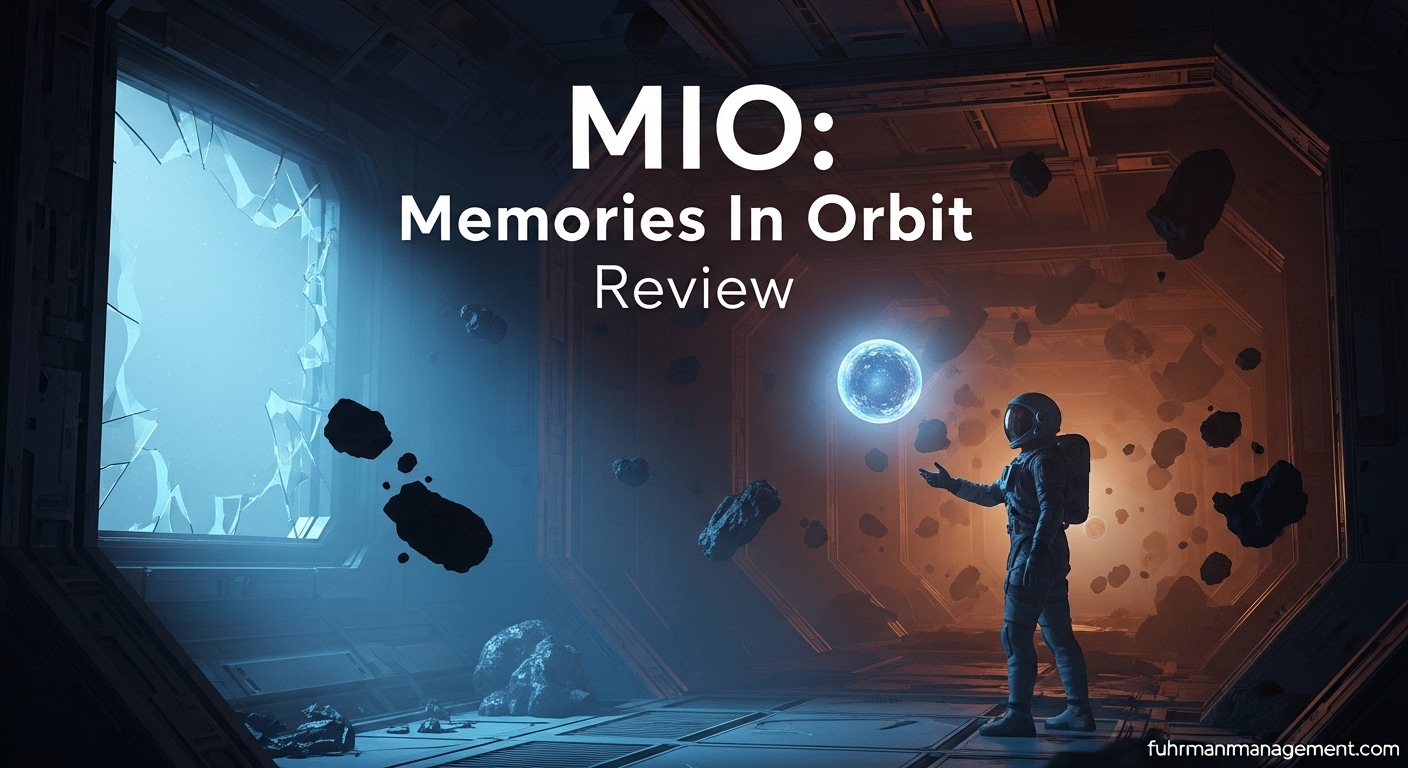
Space has always been the final frontier for exploration, but in recent years, it has also become the backdrop for some of the most relaxing “cozy games” on the market. From farming among the stars to mining asteroids, players are looking for an escape that offers tranquility rather than high-octane dogfights. Enter MIO: Memories In Orbit, a title that asks you to do the most mundane task imaginable—cleaning up garbage—in the most extraordinary setting possible. In this MIO: Memories In Orbit Review, we’ll dive into whether this interstellar janitorial sim is a therapeutic masterpiece or just a chore in disguise.
The Premise: Space Janitor with a Heart
At its core, MIO: Memories In Orbit is a game about preservation and discovery. You play as a diligent worker tasked with cleaning up a massive, abandoned space station. However, this isn’t just a simple “find the trash and delete it” scenario. The station is a museum of human history, floating aimlessly in the void. As you clear away the debris and sort the recyclables, you uncover fragments of the past—memories that tell the story of the people who once lived there.
The narrative hook is strong. It transforms the gameplay from a repetitive simulation into an archaeological dig. You aren’t just a janitor; you are a historian, piecing together a narrative that is both melancholic and heartwarming. This emotional weight is what differentiates MIO from other titles in the genre, such as Hardspace: Shipbreaker, which focuses more on the technicalities of deconstruction. Here, the focus is squarely on the feeling of the objects you handle.
Gameplay Mechanics: The Art of Decompression
The gameplay loop in MIO: Memories In Orbit revolves around a central mechanic: decompression. The station is a maze of zero-gravity corridors, some pressurized and others vacuum-sealed. To navigate and clean effectively, you must manage the air pressure in different rooms.
The Decompression Tool: A Double-Edged Sword
This mechanic is brilliant in its simplicity. You use a specialized tool to suction out air from a room, allowing doors to open and floating debris to settle or be directed into your recycling bins. However, it also introduces a layer of puzzle-solving. If you depressurize a room too quickly, you might send valuable items flying into the dark abyss, lost forever.
The physics engine deserves a shout-out here. Objects tumble, float, and collide with a satisfying realism. Catching a runaway coffee mug or navigating a floating sofa through a narrow doorway feels rewarding. It captures the clumsiness and wonder of zero-gravity movement better than many high-budget shooters.
However, it’s not without its frustrations. The controls, while generally intuitive, can feel a bit floaty (pun intended) during more delicate operations. There were moments where I found myself fighting the camera just to get the right angle to suck up a pile of wrappers. For those looking for a purely relaxing experience, these occasional control hiccups might break the immersion slightly. If you enjoy management sims, you might want to check out our thoughts on similar titles at /top-management-sims-2024/.
Aesthetic and Audio: A Floating Symphony
Visually, MIO: Memories In Orbit strikes a delicate balance between realism and stylization. The lighting is particularly noteworthy. Rays of sunlight piercing through broken windows illuminate dancing dust particles, creating a serene atmosphere that makes you want to stop and just look around. The character models and environmental textures are clean, if not ground-breaking, but the art direction carries the weight.
The audio design is where the game truly shines. There is no bombardment of orchestral scores; instead, the soundtrack is a subtle, ambient soundscape that perfectly complements the silence of space. The hum of your suit, the clatter of debris hitting your collector, and the muffled silence of the vacuum all contribute to an immersive ASMR-like experience. It’s the kind of game you play with headphones on in a dark room, letting the stress of the day melt away.
For fans of retro-futuristic designs and atmospheric gaming, this title is a must-play. It reminds me of the visual storytelling found in classics like Portal, though with a much softer, more emotional edge. You can read more about the evolution of space aesthetics in gaming over at IGN or similar industry leaders who have tracked this visual trend.
Narratives in the Trash: Uncovering Memories
While the cleaning mechanics are fun, the “Memories” part of the title is the real hook. As you clean specific sectors, you trigger audio logs, holograms, and environmental storytelling elements.
Is it a Story or a Sandbox?
This is where opinions might diverge. Some players might find the pacing of the story too slow. If you are purely interested in the gameplay loop, the narrative interruptions might feel like they are slowing down your productivity. However, I found that the story gave purpose to the labor. Cleaning a random hallway is boring; cleaning the hallway where two astronauts first fell in love is engaging.
The writing is tender and avoids being overly melodramatic. It deals with themes of loss, nostalgia, and the inevitability of time. It doesn’t have the complex branching paths of a narrative RPG like those found on Fandom, but it delivers a poignant, linear experience that respects the player’s intelligence.
Replayability and Content Depth
One potential downside for MIO: Memories In Orbit is its replayability. Once you have cleaned the station and uncovered all the memories, is there a reason to return?
Currently, the game offers a sandbox mode, which is great for those who just want to enjoy the physics and cleaning mechanics without the narrative constraints. However, the procedural generation is limited. You will likely see the same types of debris and room layouts fairly quickly. compared to endless games like Vessel or other simulation games, the content here is finite.
For completionists, there are plenty of collectibles and “Perfect Cleaning” ratings to chase in each sector, which adds some longevity. But for the average player, this is likely a “one and done” experience—albeit a memorable one.
Conclusion
MIO: Memories In Orbit is a unique entry in the cozy game genre. It successfully merges the satisfaction of cleaning simulators with a touching narrative about human connection. While it suffers from some minor control issues and a limited endgame, the journey it offers is well worth the price of admission.
It excels at creating an atmosphere of lonely beauty. It’s a game that encourages you to slow down, to pay attention to the details, and to find value in things that have been discarded. In a world obsessed with speed and consumption, a game about preserving memories in the vacuum of space feels surprisingly necessary.
Whether you are a fan of space exploration or just looking for a digital escape to calm your nerves, this title delivers. It stands as a testament to how games can evoke emotion through the simplest of actions.