
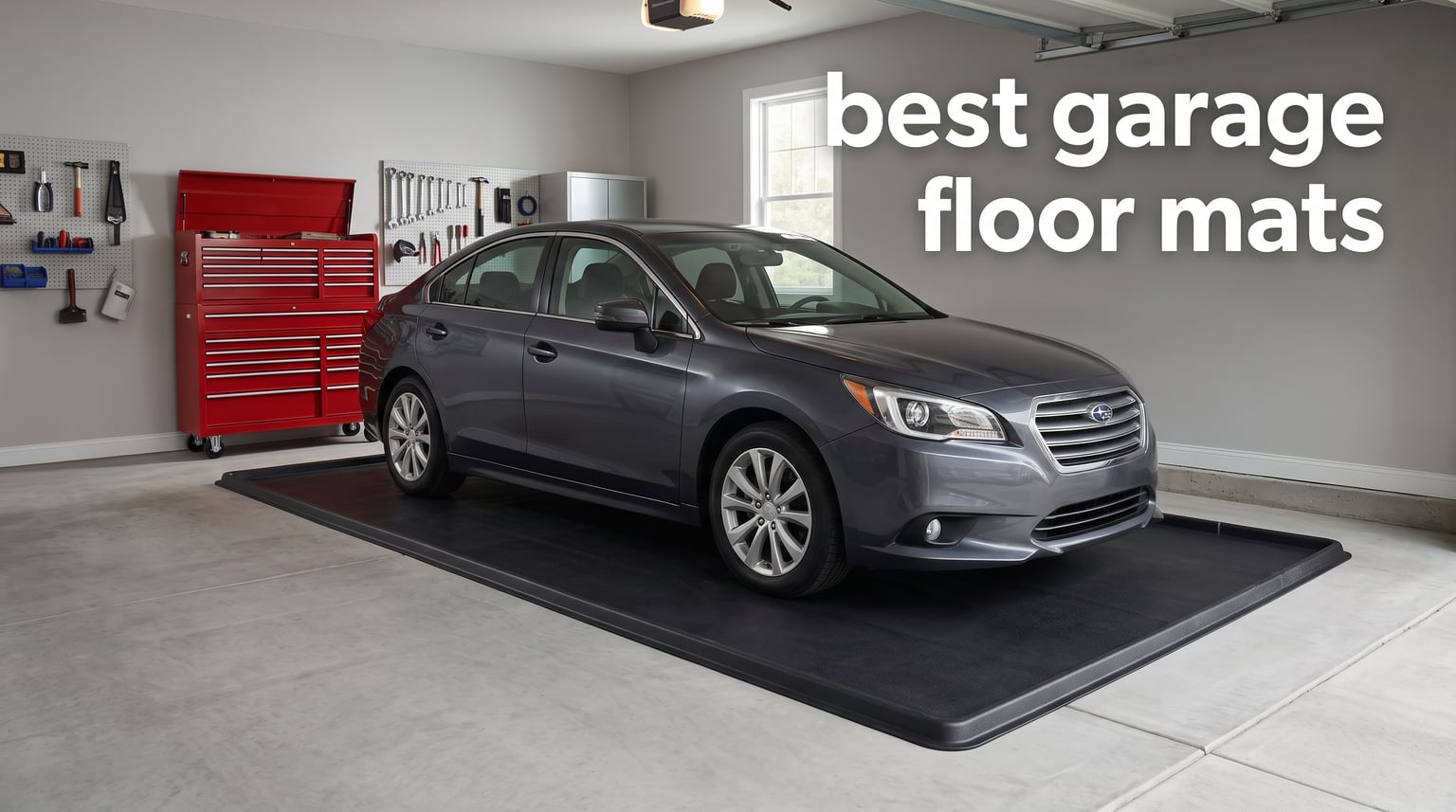
A bare concrete slab takes a surprising amount of abuse. Tires bring in grit, road salt, rain, and snow melt, while a parked vehicle or workbench can add oil, brake fluid, and other messes that are hard to remove once they reach the concrete.
The best garage floor mats give that abuse a sacrificial surface instead. They are not all meant to solve the same problem: a raised-edge containment mat holds wet snow, an absorbent pad catches drips, a PVC roll covers a broad parking bay, and interlocking tiles make a more finished garage workshop flooring surface.
I would start with the problem rather than the brand. A single car with an occasional oil drip needs a different garage floor covering from a truck that comes home covered in slush, and both differ from a workshop where traction and easy sweeping matter every day.
We compared the supplied specifications, dimensions, materials, ratings, review counts, stated cleaning methods, and reported buyer feedback for seven options. The short version is straightforward: choose Nilight for contained meltwater, AHUAWA for a broad waterproof PVC surface, Gkpvt or Cizistom for absorbent spill control, and VEVOR for a tile-based floor.
Top 3 picks answer the most common garage needs (July 2026)
These three choices cover the biggest decision split: broad waterproof coverage, winter containment, and a smaller absorbent work area. The right pick depends on whether liquids need to stay on top, soak into a pad, or drain through a rubber surface.


Nilight 8.5 x 20 FT Containment Mat
- 1.4 inch raised edge
- 1000D PVC
- squeegee included
- vehicle fit
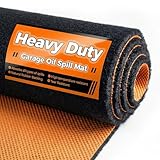
Cizistom 64 x 64 Inch Oil Spill Mat
- 1/4 inch thick
- polypropylene top
- natural-rubber backing
- cut to fit
Best garage floor mats in 2026 cover seven distinct uses
The comparison below includes every mat in this guide. Read the listed coverage and material carefully: a mat that absorbs fluid is not a containment tray, and open drainage rubber is not a full waterproof barrier.
| Product | Specifications | Action |
|---|---|---|
|
AHUAWA 8 x 21 FT Garage Floor Mat
|
|
Check Latest Price |
 Uniboho Outdoor Rubber Floor Mat
|
|
Check Latest Price |
|
Nilight Garage Containment Mat
|
|
Check Latest Price |
 Gkpvt Felt and Rubber Garage Pad
|
|
Check Latest Price |
|
Cizistom Heavy Duty Oil Spill Mat
|
|
Check Latest Price |
 Golener Heavy-Duty Garage Floor Mat
|
|
Check Latest Price |
 VEVOR Interlocking Garage Floor Tiles
|
|
Check Latest Price |
1. AHUAWA answers the need for broad waterproof parking coverage
Pros
- Large 168 square foot coverage
- Waterproof PVC surface
- Diamond anti-slip texture
- Trims to fit
- No-tool installation
Cons
- Weighs 61.9 pounds
- Limited color options
The AHUAWA is the clearest all-purpose choice when the goal is to cover a generous vehicle bay rather than spot-protect one leak. Its 8 by 21 foot format covers up to 168 square feet, which gives a car-sized parking area much more continuous coverage than a small pad.
The supplied data identifies the material as 2.8 mm heavy-duty PVC with a reinforced top layer and a diamond-plate texture. That combination points this mat toward garage floor protection from wet tires, mud, salt, and drips that you want to keep above the concrete rather than absorb.
I like the practical fit story here: it rolls out without tools and can be trimmed. The tradeoff is handling it, because the listed weight is 61.9 pounds; plan on having space to unroll it flat and help nearby if lifting a heavy roll is difficult.
Its 4.9 rating comes from 37 reviews, so the feedback pool is still small. Those buyers praise the thickness, waterproof surface, grip, and large coverage, but the rating should be read as early positive feedback rather than the broadest long-term record in this roundup.
This PVC roll is best when a vehicle bay needs one continuous surface
Choose this one for a vehicle parking space, trailer area, or workshop zone where broad coverage and a wipe-clean surface matter. The diamond texture gives a traction-focused finish, and the stated waterproof design is meant to block dirty water, oil, mud, and winter salt.
It also suits a home gym or general utility area when you want a roll-out surface instead of a grid of seams. Because it is a continuous mat, routine sweeping does not involve tile joints.
This PVC roll needs a flat, measured installation area
Measure the full parking bay before ordering, including door swings, posts, and transitions. Cutting can tailor the perimeter, but a large one-piece mat does not create a raised reservoir around meltwater.
For heavy snow, water may remain on the surface until you remove it, so a squeegee or absorbent towels remain part of the routine. Forum discussions repeatedly flag standing water as the drawback of containment-style protection, and a flat roll also needs prompt cleanup after a wet day.
2. Uniboho answers the need for a grippy drainage mat by a doorway or bench
Uniboho Outdoor Rubber Floor Mats Anti Slip Restaurant Commercial Kitchen Rubber Drainage Mat 60 x 35 Heavy Duty Mat for Garage Garden Indoor Outside Industral Pool Entrance Bar Wet Area
60 x 35 in
0.31 in rubber
Drainage holes
Pros
- Commercial-duty rubber
- Hexagonal drainage holes
- Stable non-slip grip
- Simple hose cleaning
- Works on many surfaces
Cons
- May have a rubber odor
- Must air dry after washing
The Uniboho is not a full-car parking mat, and that distinction makes it more useful, not less. At 60 by 35 inches and 0.31 inches thick, it is a targeted rubber garage mat for an entrance, workbench, utility sink, or the place where wet shoes and tools land.
Its heavy-duty rubber construction uses large hexagonal holes to reduce slippery liquids and oils underfoot. Instead of trapping water against a solid top, the design lets liquid pass through, which is useful where drainage is acceptable below the mat.
With 628 reviews and a 4.7 rating, this is one of the better-established listings here. Buyers report strong grip, durability, and simple cleaning by vacuuming, sweeping, or rinsing with a hose.
The key limit is simple: open holes do not protect concrete from fluids in the way a waterproof garage floor mat does. Put it where safer footing is the priority, not beneath a leaking engine or where you must contain saltwater.
This rubber mat is best for wet walkways and standing work zones
Use the Uniboho near a garage door, at a service bench, or in a transition from outdoors to a workshop. It can also work in other wet-duty settings because the stated surface is intended to stay grippy on cement, tile, wood, and vinyl.
The holes are helpful if you are standing on a wet surface and want less pooling beneath your shoes. They are also why it makes sense as a complement to, rather than a replacement for, a vehicle mat.
This rubber mat needs ventilation and a floor that can drain
Some buyer feedback mentions an initial rubber smell, so let the mat air out before placing it in a closed garage. After hose cleaning, it needs to air dry before being put back into service.
Do not expect the drainage pattern to catch oil or snow melt. If the liquid under it must stay off the slab, choose a backed absorbent pad or raised-edge containment mat instead.
3. Nilight answers the need to contain snow, rain, and road salt
Nilight Garage Containment Mat 8'6" x 20' PVC Garage Floor Mat with 1.4" Raised Foam Edge Waterproof Heavy Duty Garage Parking Mat for SUVs Pickup Trucks Vans
8.5 x 20 ft
1.4 in raised edge
1000D PVC
Pros
- Raised edge contains meltwater
- Large SUV and truck coverage
- Tear-resistant PVC
- Includes squeegee and prep items
- One-year warranty
Cons
- Fluid must be removed manually
- Only 28 reviews
The Nilight is the specialist pick for a winter garage. Its 8 foot 6 inch by 20 foot footprint fits the stated use with SUVs, trucks, vans, and cars, while the 1.4 inch raised foam edge is designed to keep snow melt, rainwater, mud, and road salt inside the parking area.
That lip is the important difference between a containment mat and a flat garage floor covering. If wet tires bring gallons of meltwater into a garage, the edge creates a physical boundary rather than relying only on a waterproof top surface.
The supplied listing describes heavy-duty waterproof 1000D PVC intended to resist tearing, curling, and cracking. It also includes a squeegee, hook-and-loop tape, and alcohol prep pads, which speaks to the practical setup and cleanup work that a containment design requires.
The early feedback is promising at 4.7 from 28 reviews, with no negative ratings shown in the supplied distribution. Still, I would treat the small review count as a reason to pay attention to fit and edge adhesion during the first weeks of use.
This containment mat is best for garages that see regular winter meltwater
Pick Nilight if snow, rain, and road salt are the messes you need to manage. The smooth PVC surface can be wiped, rinsed, vacuumed, or squeegeed according to the product data, making it easier to remove liquid after it has been captured.
It is also a sensible choice where the vehicle must stay within a defined parking rectangle. The dimensions are large enough for many SUVs and pickup trucks, but measure mirrors, doors, and the actual tire path first.
This containment mat requires planned water removal
A raised edge captures liquid; it does not make that liquid disappear. Garage owners in forum discussions make this point often: evaporation is slow in a cold or closed space, so plan to squeegee or soak up standing water before it is tracked out.
Clean and dry concrete gives the hook-and-loop tape its best chance to hold. Keep the foam border clear of objects that could compress or displace it, and do not use this design as a substitute for addressing a persistent vehicle leak.
4. Gkpvt answers the need for a large absorbent pad under a vehicle
Pros
- Absorbs up to 10 times its weight
- Backed to block leaks
- Non-slip surface
- Cuts with scissors
- Washable and reusable
Cons
- Felt needs deep cleaning
- May not cover very large vehicles
The Gkpvt is built around a different approach to garage mat for oil leaks: absorption. Its 7 foot 5 inch by 17 foot format pairs a high-density felt top with a durable rubber backing, so the top is intended to take in fluid while the base blocks it from reaching the concrete.
The product states that the felt can absorb up to 10 times its weight in oil, gasoline, coolant, and other automotive fluids. That is useful under an older vehicle or in a workspace where drips are occasional but inconvenient.
Unlike a smooth PVC roll, the felt surface is not a quick squeegee-and-go solution. It is washable and reusable, but the data and review insights make clear that the top will need an occasional deeper clean after it has done its job.
The listing has a 4.6 rating from 54 reviews. Review feedback points to effective absorption and grip, while its moderate review total means the stronger claim is the clear material design, not a huge sample of long-term user reports.
This absorbent pad is best when drips need to be captured, not corralled
I would choose Gkpvt beneath an engine bay, under a project car, or in a parking space with recurring minor fluid drips. The rubber backing is intended to lock in the spill, while the felt gives the liquid somewhere to go instead of leaving it on a slick surface.
The cut-to-fit feature is useful around posts, tool chests, and odd corners. It can suit a garage gym or utility zone as well, but its main strength is fluid management.
This absorbent pad needs cleaning before it becomes saturated
Inspect the felt regularly, especially after a known leak. A saturated absorbent top should be cleaned and air dried according to the stated care method instead of being left in place indefinitely.
Do not use it as a raised-edge snow garage mat. Meltwater can be large in volume, and the correct response for that job is a containment lip rather than expecting an absorbent textile layer to deal with all of it.
5. Cizistom answers the need for a compact, thick oil-spill barrier
Heavy Duty Oil Spill Mat, 1/4" Thick, Garage Floor Mat for Under Car, 64" X 64", Waterproof, Rubber Backing Protects Floor, Reusable, Absorbs All Types of Spills, Oil Absorbent Pads (Black)
64 x 64 in
1/4 in thick
Natural rubber base
Pros
- Thick double-layer build
- Strong natural-rubber backing
- Absorbent polypropylene top
- Resists slipping and tearing
- Cleans by hose or vacuum
Cons
- Small for a full vehicle
- No stated extended warranty
The Cizistom is a focused under-car mat rather than a broad garage floor roll. Its 64 by 64 inch footprint is designed for placing beneath the area that drips, and its 1/4 inch double-layer construction is described as three times thicker than typical market products.
The top layer uses premium polypropylene fabric to absorb oil spills and dirt. Under it, a natural-rubber backing supplies grip, tear resistance, and a barrier against water and oil moving down to the floor.
This listing has a 4.5 rating from 530 reviews and a strong category rank in the supplied data. That is a meaningful amount of customer feedback compared with several newer products, and review insights repeatedly cite the thickness and natural-rubber backing as standout points.
For a small fluid problem, a compact mat can be easier to lift, wash, and replace in a routine than an entire floor covering. It will not make a full parking bay look finished, and it may take more than one mat to protect a larger area.
This oil-spill mat is best for a known leak location
Put the Cizistom where a vehicle, lawn equipment, or workbench has a predictable drip zone. The absorbent top and waterproof backing are the right pairing when the goal is to catch a small problem before it stains concrete.
It is also a practical choice for a utility area because the listing allows cutting to fit. Keep the cut edge neat and position the whole mat flat so its non-slip backing can contact the slab.
This oil-spill mat needs realistic coverage expectations
At 64 by 64 inches, it does not cover the full length or width of a car parking space. Measure the drip location instead of assuming it will reach from tire to tire or bumper to bumper.
A persistent leak deserves mechanical attention, even if the mat protects the concrete in the short term. Clean the mat by vacuuming, shaking, or a soapy hose rinse, then let it air dry before returning it beneath the vehicle.
6. Golener answers the need for a long absorbent parking mat
Pros
- Long vehicle-size coverage
- Absorbent surface
- Waterproof rubber backing
- Cuts without fraying
- No harsh odor stated
Cons
- Heavy spills need extra cleaning
- Availability can vary
The Golener brings the under-car absorbent approach to a vehicle-length format. It measures 17 feet by 7 feet 4 inches, has a stated thickness of 4 mm, and combines a polyester-fiber surface with a waterproof rubber backing.
That surface is meant to trap oil, brake fluid, and other spills, while the backing prevents leakage to the concrete. The design is a strong match for a garage that needs broad parking coverage but has fluids as the main concern rather than deep snow containment.
Its 4.4 rating comes from 656 reviews, the largest feedback base among the long absorbent mats in this list. Buyers commonly praise absorbency, durability, and cleanup, while the supplied cons point out that heavy oil spills can call for extra cleaning.
The ability to cut the material with scissors without fraying helps it fit beside walls and around equipment. The listing also identifies it as BPA- and phthalate-free, with no harsh odors stated, which can matter in a frequently used enclosed garage.
This long parking mat is best for broad absorbent vehicle coverage
Choose Golener for a car or SUV space where drips, brake fluid, and general grime are more likely than large volumes of snow melt. Its dimensions make it a better one-piece option than a square spot pad when you want coverage along much of the vehicle.
The mat can also serve beneath workout equipment or in a workshop, according to the listed uses. Its polyester surface and rubber base give it a clear job: take in the mess on top while keeping the slab dry below.
This long parking mat needs a deliberate wash-and-dry routine
For cleaning, the supplied instructions call for mild soap, a hose rinse, and hanging it to dry. Build that into the choice, because an absorbent mat needs more drying time than a smooth PVC surface.
Do not wait until stains are deeply set. Address fresh spills early, and use a separate raised-edge mat if winter weather sends a large volume of water into the garage.
7. VEVOR answers the need for a tile-based garage floor surface
VEVOR Garage Floor Tiles 12 x 12 x 0.53 inch, Interlocking Design Ease of Installation Double-Sided Texture Non-Slip Sturdiness, for Garages, Basements, Repair Shops, Graphite Gray, 50 Pack
12 x 12 in tiles
0.53 in thick
5500 lb capacity
Pros
- Interlocking no-glue setup
- 5500 pound load capacity
- Textured non-slip surface
- Waterproof tiles
- Easy to mop or vacuum
Cons
- Tile joints need cleaning
- Older tile system is incompatible
The VEVOR set is for the buyer who wants garage flooring rather than a single parking mat. These are 12 by 12 inch polypropylene tiles, 0.53 inches thick, with a double-sided textured surface and a stated 5,500-pound load capacity.
Instead of rolling out a sheet, you connect individual pieces with six interlocking loops per tile. The product says no tools, glue, or extra manpower are needed, and the 3D diamond texture is intended to add slip resistance under vehicles and foot traffic.
This format works especially well when a garage doubles as a workshop, repair area, basement, or warehouse space. You can cover a defined zone with a structured surface, then vacuum or mop it as part of normal cleaning.
The tradeoff is seams. Forum users frequently mention that cleaning between tiles takes more attention, and the supplied review data includes a 4.1 rating from 838 reviews with 12 percent of ratings at one star. The current interlocking system is also not compatible with products bought before the stated upgrade year.
These interlocking tiles are best when the garage needs a finished modular surface
VEVOR makes sense for a garage workshop flooring project where the floor is used for more than parking. The 50-pack tile format allows a configurable layout, and the listed load capacity supports the stated use with large trucks.
The waterproof polypropylene construction and diamond texture can make routine dirt and dust easier to manage than a textile mat. Start from a square wall or doorway, dry-fit the pattern, and leave enough time to connect each row evenly.
These interlocking tiles need attention at seams and compatibility
Tiles do not act like a sealed containment tray. Liquids can reach the seams, so a tile floor is better for a clean, general-use garage than for catching a major oil leak or winter meltwater event.
Use only tiles from the compatible system when extending an existing installation. Sweep or vacuum regularly, and lift or inspect a section if fluid has worked beneath the surface rather than assuming the top texture has handled it.
The right garage floor mat starts with the type of mess you need to control
A garage mat is a protective covering between concrete and daily use. The first buying decision is whether you need to contain liquid on a smooth surface, absorb it into a fabric top, drain it through rubber holes, or create a modular floor over the slab.
Choose a raised-edge containment mat when winter snow, rain, mud, and saltwater arrive on tires. Nilight is the fitting example here because its 1.4 inch foam edge is expressly designed to form a boundary around the parking area.
Choose a flat waterproof PVC roll when you want a broad, continuous barrier against road grime, oil, mud, and salt. AHUAWA’s 2.8 mm PVC construction and diamond texture are suited to that parking-bay role, but water still needs removal because there is no raised perimeter.
Choose an absorbent, rubber-backed mat for drips and spills. Gkpvt, Cizistom, and Golener use this approach: a textile top takes in automotive fluids, and the backing is there to keep them from reaching concrete.
Choose open-drain rubber only when safer footing and rinse-through cleaning are the main jobs. Uniboho’s holes help reduce slippery pooling, but they deliberately do not make it a garage mat for oil leaks.
Choose interlocking tiles when the goal is a general-purpose garage workshop flooring surface. VEVOR’s tile construction supports a configurable, textured floor, while a dedicated containment or spill mat remains smarter for a leak-prone vehicle.
Material choice answers how the mat will behave with water, oil, and traffic
PVC vinyl is commonly selected for a waterproof garage floor mat because a smooth sheet can be swept, wiped, rinsed, or squeegeed. It is a surface barrier, so it performs best when you remove fluids before they spread or get tracked away.
Rubber gives a stable, grippy feel and can be useful around doors or workstations. A rubber-backed textile mat adds a barrier below an absorbent top; open-hole rubber, by contrast, lets liquid through and focuses on traction.
Polypropylene tiles create a firm modular surface. Their 0.53 inch VEVOR profile and stated load capacity make them a different category from a soft pad, but tile gaps deserve regular cleaning after dusty work or fluid spills.
Thickness alone does not decide durability. A 1/4 inch Cizistom pad is intended for localized absorption, 2.8 mm AHUAWA PVC is intended for broad coverage, and a 0.53 inch VEVOR tile is intended for supporting vehicles; compare thickness within the material and use case, not in isolation.
Correct sizing answers whether tires, doors, and drip zones stay protected
Measure the actual area before selecting any garage floor covering. For a vehicle mat, measure the tire-to-tire width, vehicle length, door swing clearance, and the distance to walls or storage; for a leak pad, locate the engine, transmission, or equipment drip zone.
Do not assume a nominal garage size tells you what will fit. A vehicle may sit off-center, a door may cover part of the floor, and a post or cabinet can force a custom perimeter.
Cut-to-fit designs can solve those edges, but make the cut after the mat has relaxed flat and you have marked the line twice. AHUAWA, Gkpvt, Cizistom, and Golener are all described as trimmable, while interlocking tiles allow a modular layout instead of cutting one giant piece.
For a containment mat, leave the raised edge intact around the area where water needs to stay. A poorly placed lip or an uneven surface can give meltwater an escape route, which defeats the reason for choosing that style.
Clean, dry concrete answers how to prevent shifting and curling
Sweep grit and loose debris from the slab, then clean oil residue before laying down a mat. Let the concrete dry fully, because moisture below a covering can add odor, slow drying, and interfere with any included fastening material.
Roll-out mats deserve time to relax flat after unpacking. Corners and edges are the places to inspect first, since forum users regularly report moving, wrinkling, or curling as the frustrating part of owning a garage mat.
Keep heavy objects off a raised containment border and do not drive across an edge that is not positioned as intended. For Nilight, use the supplied prep items as directed and keep the attachment area clean.
For tiles, use a level, clear surface and work from a straight reference line. Check each connection as you go, because a small misalignment can multiply across a larger garage floor.
Climate and cleanup answers how long a mat can stay useful
Snow and salt need containment plus active removal. A raised-edge mat can hold meltwater, but it needs a squeegee, towels, or another method to get that liquid out; no contained pool should be ignored for days in a closed garage.
For ordinary dirt and wet tires, smooth PVC is simple to sweep or wipe. AHUAWA’s stated waterproof design and Nilight’s smooth PVC surface are both geared toward that type of cleanup, though only Nilight has the raised edge.
For oil, coolant, and brake fluid, act quickly even when using an absorbent pad. Gkpvt, Cizistom, and Golener are reusable according to their listings, but washing, rinsing, and complete air drying are part of the ownership work.
For rubber drainage mats, hose rinse as needed and allow them to dry before reuse. For interlocking tiles, vacuum or mop the top, then inspect below or between sections after a major spill because seams are a known maintenance point.
FAQ answers the questions people ask before buying garage floor mats
Are garage floor mats a good idea?
Garage floor mats are a good idea when you want to protect concrete from vehicle grime, road salt, snow melt, oil drips, and workshop wear. Pick a raised-edge mat for water containment, a waterproof roll for a broad barrier, or an absorbent backed pad for recurring drips. The mat still needs cleaning and cannot fix a mechanical leak.
What is the best flooring for garage floors?
The best flooring depends on use. A waterproof PVC roll such as AHUAWA suits broad parking coverage, Nilight suits snow containment, Cizistom or Gkpvt suits oil drips, and VEVOR tiles suit a finished workshop-like surface. Match the material to the mess you expect most often.
Is anything better than WeatherTech?
There is no single product that is better for every garage use. A raised-edge option such as Nilight may fit snow containment needs, while an absorbent backed pad such as Golener or Cizistom can fit a known oil-drip location better. Compare coverage, whether liquid must be contained or absorbed, and cleanup method rather than relying on one brand name.
What is the best thing to put on my garage floor?
Put a product on the floor that matches the job: a containment mat for snow and rain, a PVC roll for broad waterproof coverage, an absorbent rubber-backed mat for oil leaks, a drainage rubber mat for a wet entrance, or interlocking tiles for a garage workshop. First measure the space and clean and dry the concrete.
The best garage floor mats match protection to the actual garage problem
For 2026, AHUAWA is our broad waterproof roll recommendation, Nilight is the clear snow-containment choice, and Cizistom is the compact option for a known drip. Gkpvt and Golener make sense when you want an absorbent vehicle-length surface, while VEVOR gives a garage workshop a modular tile floor.
Measure first, clean the concrete, and choose the product that manages the mess you actually have. That simple match is what turns the best garage floor mats from a cosmetic purchase into useful floor protection.