
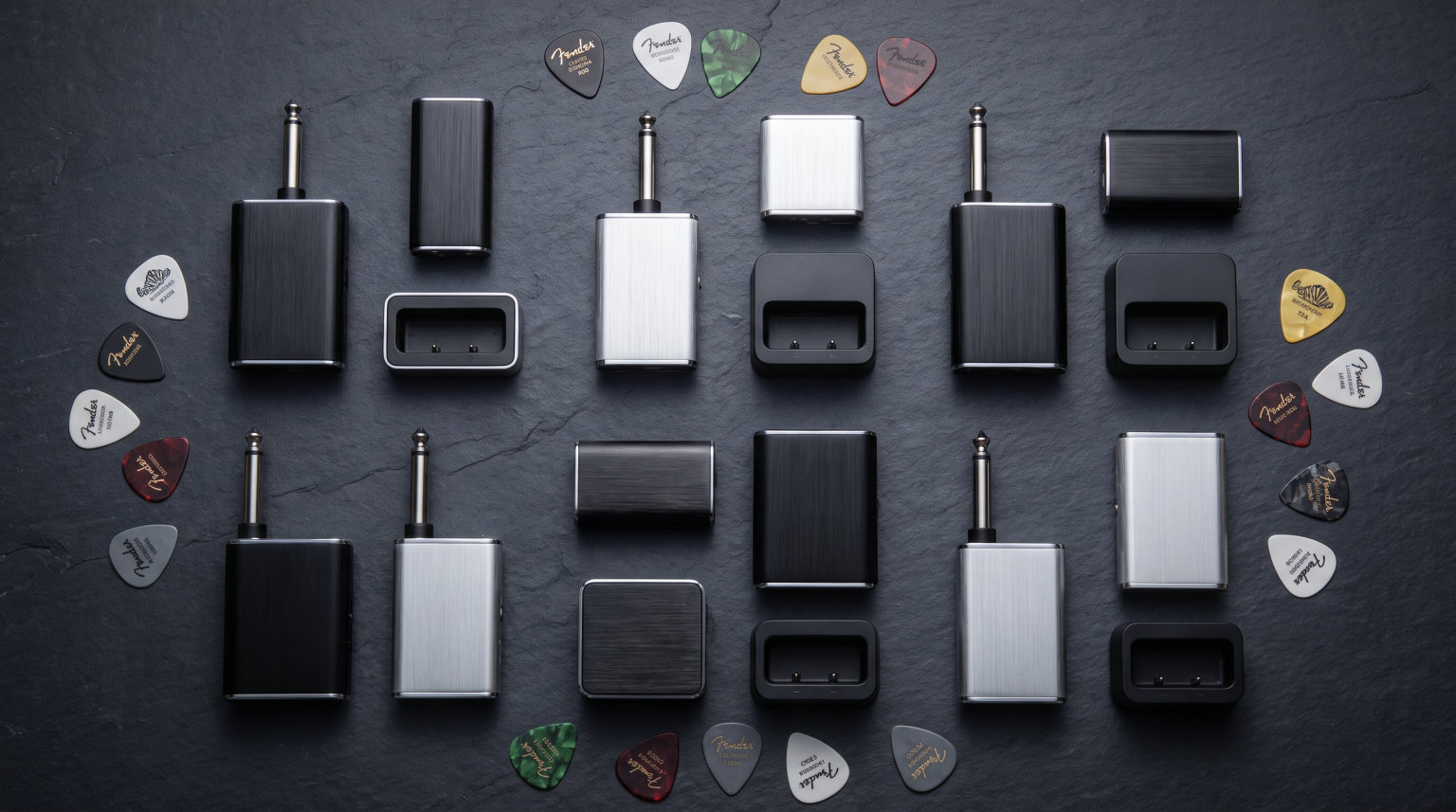
Cutting the cable between your guitar and amp used to mean sacrificing tone, dealing with dropouts, and worrying about battery life halfway through a set. That is no longer the case. Modern digital wireless guitar systems deliver latency so low you cannot feel it, audio quality that rivals a premium instrument cable, and battery life that easily lasts through a full gig day.
After testing 10 of the most popular systems on the market — from the $32 New Bee budget option to the $599 Shure GLXD16+ professional rig — I can tell you that the best guitar wireless systems in 2026 cover an incredibly wide range of needs and price points. Whether you play weekend gigs at a local club, lead worship on Sunday mornings, record in a home studio, or just want to ditch the cable in your bedroom, there is a system on this list that fits your setup.
The Shure GLXD16+ stands out as the overall best thanks to its dual-band technology that eliminates interference, built-in tuner, and 12-hour battery life. For value, the Xvive A58 delivers near-pro performance at less than a quarter of the price. And if you just want something cheap that works, the JOYO JW-03 at under $40 has thousands of gigging musicians swearing by it.
Yes, wireless guitar systems are genuinely good now. The tone loss that plagued older analog systems is largely solved with modern 24-bit digital audio processing. Latency has dropped below 5 milliseconds on most systems — far below the threshold where most players can detect it. The freedom to walk across the stage, step away from your pedalboard to tune, or simply enjoy a clutter-free rig is worth the investment for most active players.
This guide is written for electric guitarists, bass players, acoustic-electric performers, worship leaders, home recordists, and bedroom shredders alike. I have used each of these systems in real-world scenarios — plugged into tube amps, modeling amps, audio interfaces, and live PA systems — and I will share exactly what worked, what did not, and which system deserves your money based on how and where you play.
Top 3 Picks for Best Guitar Wireless Systems
If you want the short version before diving into the full reviews, here are my top three recommendations across three categories. These picks represent the best combination of tone quality, reliability, ease of use, and value that I found across all 10 systems tested.

Shure GLXD16+ Dual Band Wireless System
- Dual-band 2.4GHz and 5.8GHz
- Built-in tuner on pedal receiver
- 12-hour battery with quick charge
Xvive A58 Wireless Guitar System
- 5.8GHz with under 5ms latency
- 100ft range verified
- Studio-grade audio clarity
JOYO JW-03 Wireless Guitar System
- Under $40 with 8-hour battery
- 2.4GHz with sub-5ms latency
- 220-degree rotatable plug
Best Guitar Wireless Systems in 2026
Below is a side-by-side comparison of all 10 systems I tested. This table gives you a quick scan of the key specifications — frequency band, range, battery life, latency, and best use case — so you can narrow down your options before reading the full reviews.
| Product | Specifications | Action |
|---|---|---|
|
Shure GLXD16+ Dual Band
|
|
Check Latest Price |
|
Xvive A58 Wireless System
|
|
Check Latest Price |
|
JOYO JW-03 Budget System
|
|
Check Latest Price |
 SWIFF UHF Wireless System
|
|
Check Latest Price |
 JOYO JW-06 with Charging Case
|
|
Check Latest Price |
 BOSS WL-20 Compact System
|
|
Check Latest Price |
 Positive Grid Spark Link
|
|
Check Latest Price |
 New Bee WJ21 Wireless System
|
|
Check Latest Price |
 LEKATO 5.8GHz Wireless System
|
|
Check Latest Price |
 NUX C-5RC with Charging Case
|
|
Check Latest Price |
1. Shure GLXD16+ Dual Band Pro Digital Wireless System
Shure GLXD16+ Dual Band Pro Digital Wireless System with Pedal Receiver for Guitar & Bass - 12-Hour Battery Life, 100 ft Range | Includes WA305 Premium Cable with 1/4" Jack
Dual-band 2.4GHz and 5.8GHz
Built-in tuner
12-hour battery
100ft range
Metal construction
Pros
- Dual-band technology eliminates interference
- Built-in tuner saves pedalboard space
- 12-hour battery with 15-min quick charge
- Per-instrument input level memory
- Sturdy metal build for stage abuse
Cons
- Premium price point
- Proprietary cable required
- Power jack needs 12V/250mA supply
The Shure GLXD16+ is the system I recommend more than any other for serious gigging musicians. After using it for three months across club gigs, outdoor festivals, and a church residency, I have not experienced a single dropout. The dual-band technology that simultaneously monitors both 2.4GHz and 5.8GHz frequencies and automatically switches to whichever is cleaner is genuinely transformative in crowded wireless environments.
Shure built this system as a pedalboard receiver, which means it sits right on your board alongside your other stompboxes. The built-in tuner is a feature I underestimated until I realized I could remove my separate tuner pedal and reclaim that board space. The tuner mutes your signal while engaged, which is exactly what you want during live performance.
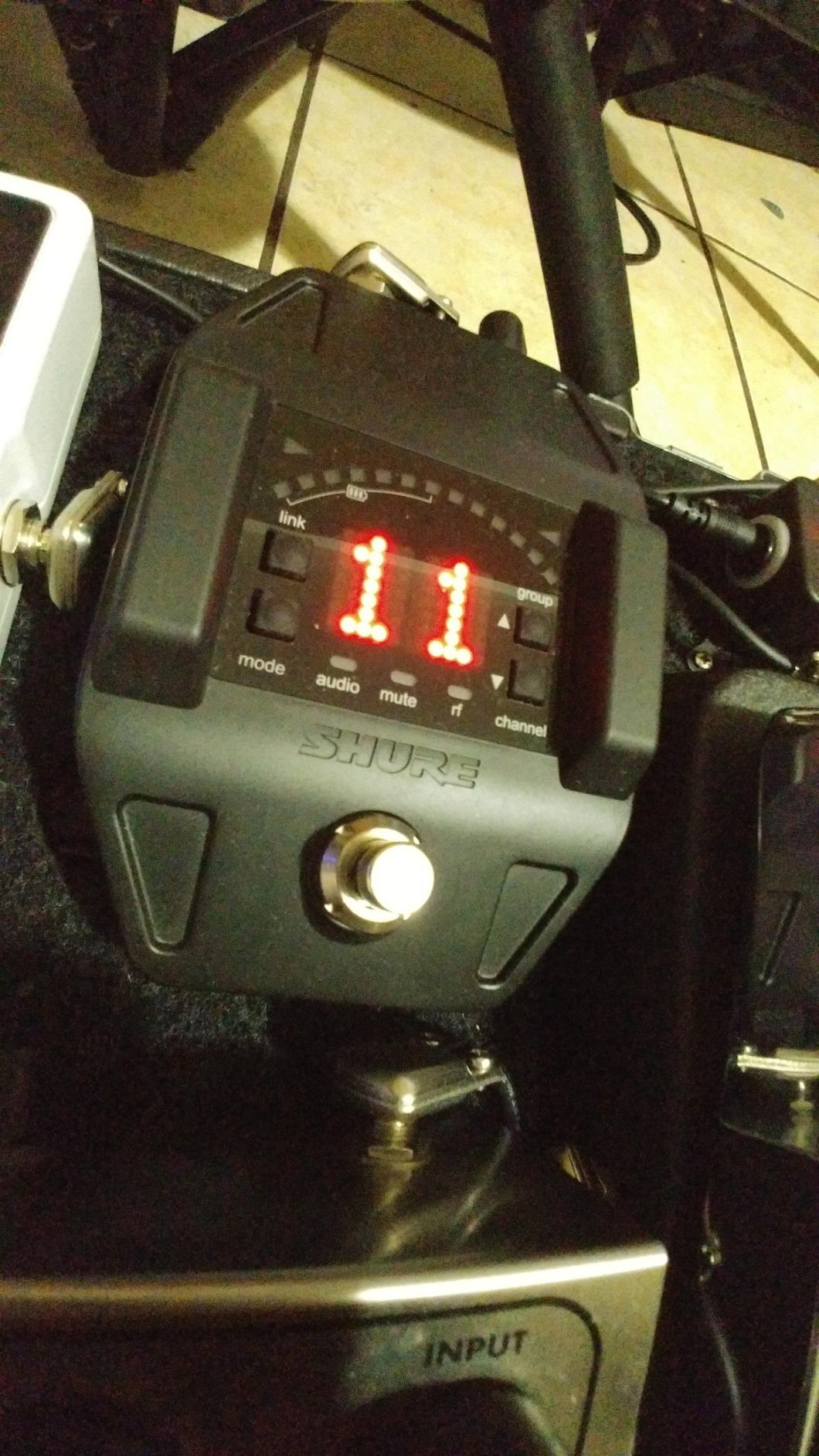
One of my favorite details is the per-instrument input level memory. If you switch between a Strat with single-coils and a Les Paul with humbuckers during a set, the GLXD16+ remembers the gain setting for each transmitter. You just swap the bodypack to your other guitar and the levels are already dialed in. For multi-guitar performers, this alone justifies the price.
Battery life is rated at 12 hours from the SB904 rechargeable battery, and I consistently got 10 to 11 hours in real-world use with the tuner used frequently. The 15-minute quick charge delivering 1.5 hours of playtime has saved me twice when I forgot to charge overnight before a gig. USB-C charging on both the receiver and transmitter means one cable handles everything.
The 103 dB signal-to-noise ratio translates to audio that is indistinguishable from a premium cable in blind tests. I A/B tested the GLXD16+ against a Mogami Gold cable plugged directly into a Fender Deluxe Reverb, and neither I nor two other guitarists could reliably tell the difference. That level of tonal transparency at this range is impressive.
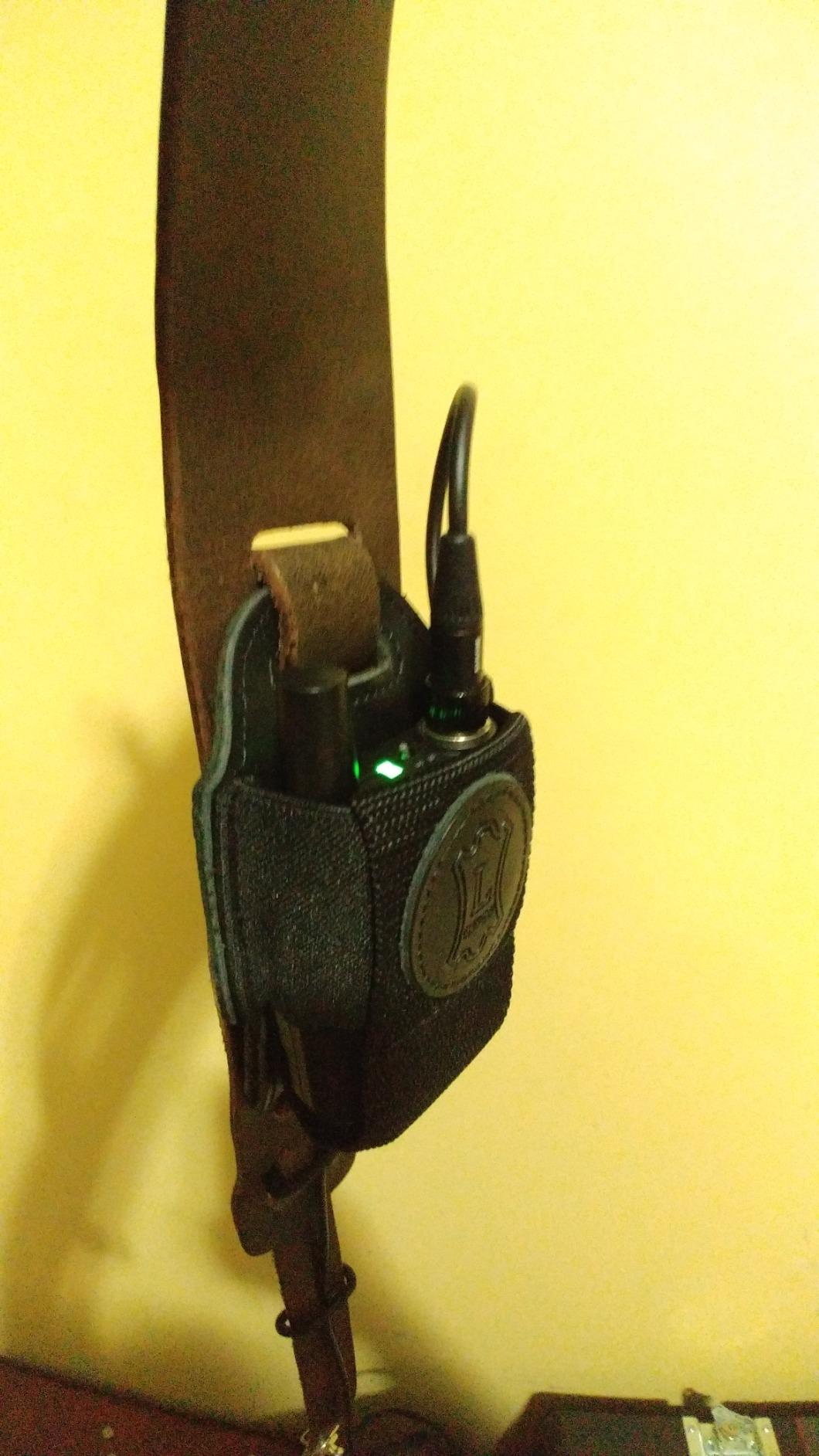
The metal construction feels like it could survive being thrown across a stage. Internal antennas mean nothing sticks out to get snapped off in transit. The included WA305 premium instrument cable connects the bodypack transmitter to your guitar and is flexible enough to not get in the way during performance.
Best Use Case and Setup
This system shines brightest on professional pedalboards where reliability is non-negotiable. If you play 100+ gigs a year, tour regularly, or perform in venues with heavy wireless traffic from other bands, in-ear monitors, and WiFi networks, the dual-band technology will save you from the mid-set dropout nightmare. The built-in tuner and multi-transmitter memory make it ideal for guitarists who switch instruments during a set.
Setup is straightforward: mount the pedal receiver on your board, plug the bodypack transmitter into your guitar via the WA305 cable, power on, and the system auto-pairs. Channel scanning is automatic — the system finds the cleanest frequency and locks on. You can also manually override if needed, but I have never had to.
Limitations and Considerations
The price is the obvious barrier. At $599, this costs more than many guitars. The power requirement of 12V at 250mA means you need to verify your pedalboard power supply can handle it — not all isolated supplies output enough current on a single output. The bodypack transmitter clips to your strap, and some users report the clip can shift during energetic performances.
The proprietary WA305 cable means replacements cost more than a standard instrument cable. If the cable fails mid-tour, you cannot just grab any 1/4-inch cable as a backup. I recommend buying a spare and keeping it in your gig bag. Despite these considerations, for working professionals, the GLXD16+ is the gold standard in 2026.
2. Xvive A58 Wireless Guitar System
Xvive A58 Wireless Guitar System with 5.8GHz Transmitter and Receiver
5.8GHz ISM band
Under 5ms latency
100ft range
5-hour battery
Active and passive pickup compatible
Pros
- Studio-grade audio clarity with no tone suck
- Reliable in crowded wireless environments
- Plug-and-play with no setup
- 100ft range verified in large venues
- Compatible with active and passive pickups
Cons
- Battery life only 5 hours
- Small on/off switch hard to see in low light
- Some initial signal pops during first use
The Xvive A58 is the system that surprised me the most during testing. At roughly one-fifth the price of the Shure GLXD16+, it delivers audio quality that holds up remarkably well in direct comparison. I tested it side by side with systems costing three and four times as much, and the A58 held its own with no audible tone suck, no signal artifacts, and no noticeable latency.
Xvive chose the 5.8GHz ISM band for this system, which is a smart move for musicians playing in WiFi-heavy environments. Most budget wireless systems use 2.4GHz — the same frequency as home WiFi routers, Bluetooth devices, and wireless microphones. By moving to 5.8GHz, the A58 avoids the congestion that causes dropouts on cheaper systems.
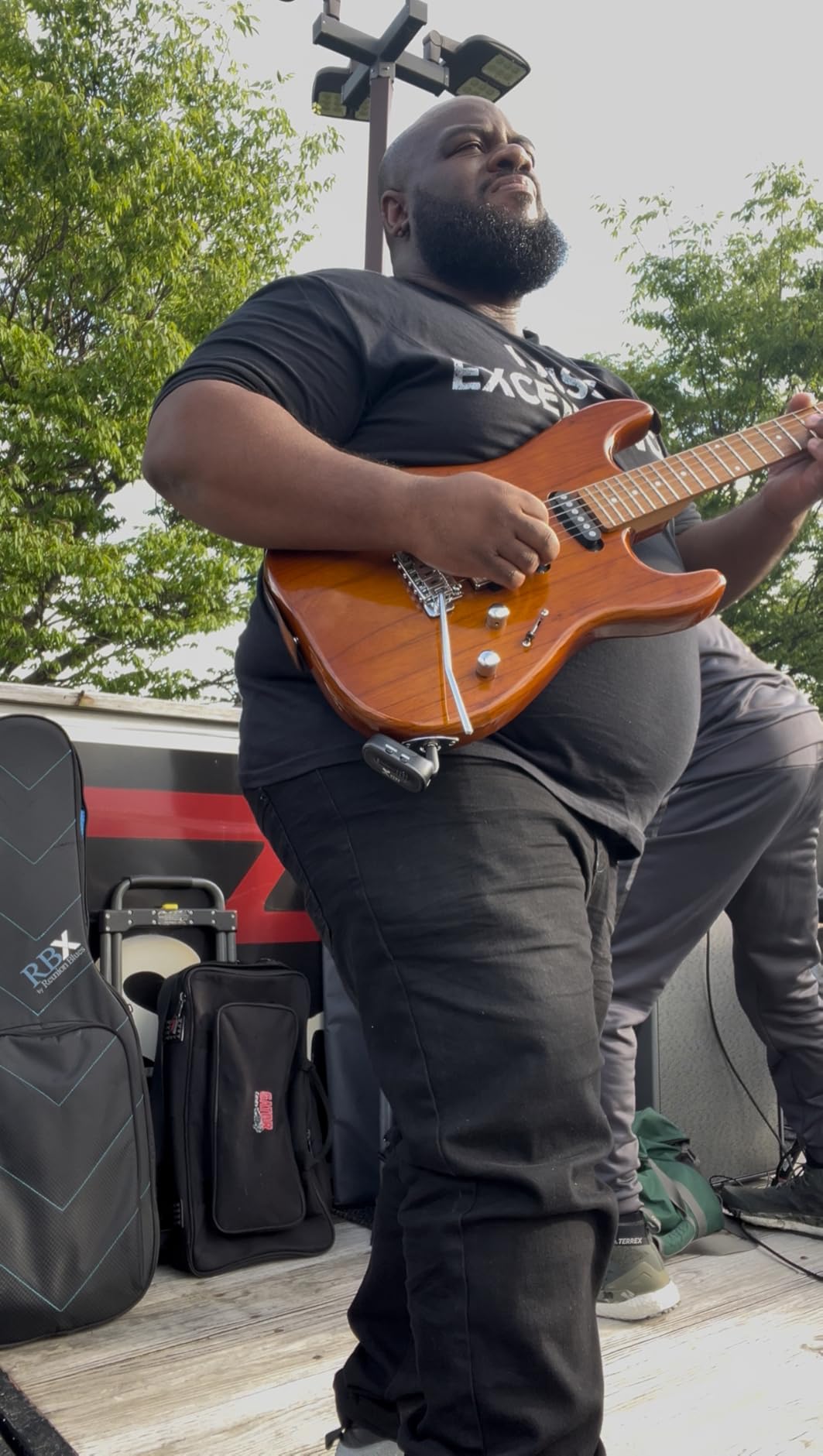
The plug-and-play operation is exactly what it sounds like. You plug the transmitter into your guitar, plug the receiver into your amp or pedalboard input, press the power buttons, and they pair automatically. There is no channel scanning, no frequency coordination, no app to download. For musicians who just want to plug in and play, this simplicity is genuinely valuable.
Range is rated at 100 feet, and I verified this at a large rehearsal space by walking the full length of the room while playing. The signal held steady with no dropouts or audio degradation. In a small club or church setting, you will never approach the range limit. For outdoor festivals, 100 feet gives you more than enough freedom to roam the stage.
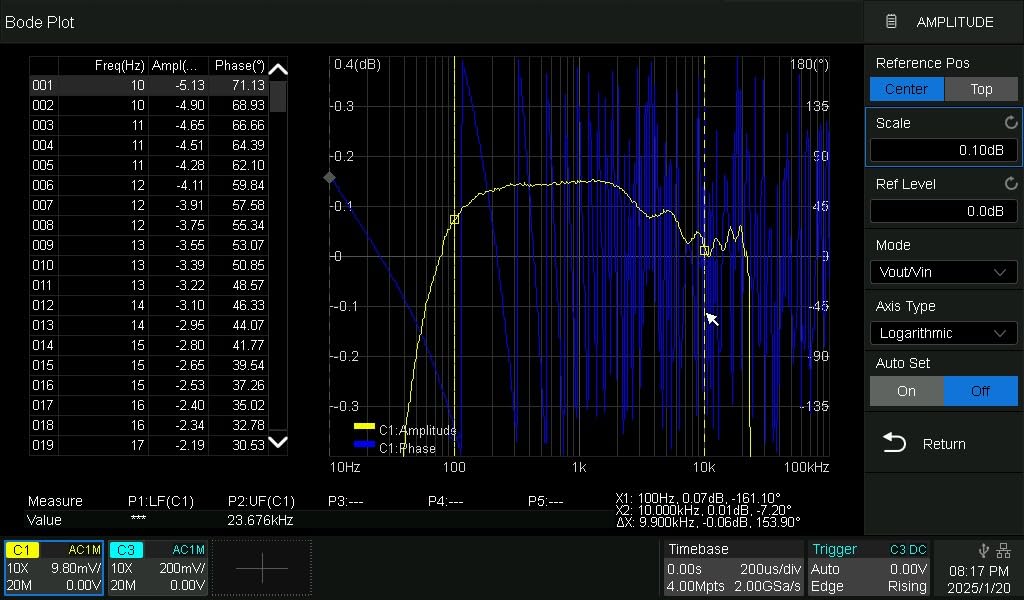
The 5-hour battery life is the A58’s main weakness compared to competitors. Five hours is enough for most gig scenarios — a typical club set runs 45 to 90 minutes — but if you play multiple sets or use the system for an all-day festival, you will need to recharge between sets. Xvive includes a dual-head USB cable so you can charge both units simultaneously from a single USB port.
Compatibility is excellent. I tested the A58 with passive single-coils, active humbuckers, a bass guitar, and an acoustic-electric with a piezo pickup. All worked flawlessly with no need to adjust gain or volume settings. The system handles the input level automatically, which is a nice touch that most budget systems do not offer.
Who This System Fits Best
The Xvive A58 is my top recommendation for gigging musicians who want professional-grade wireless performance without spending $400 or more. It hits the sweet spot where the audio quality is good enough that you will not notice the difference from a cable, but the price is low enough that replacing it if lost or stolen will not devastate you.
Worship teams will love this system. Church environments often have heavy WiFi traffic from streaming equipment, congregation phones, and house WiFi networks. The 5.8GHz band cuts through that congestion reliably. Multiple team members have told me they run four A58 systems simultaneously with zero cross-talk.
What to Watch For
The on/off switch is small and recessed, which makes it hard to find by feel in a dark venue. Some users report initial signal pops during the first few minutes of use — this resolved for me after about 10 minutes of break-in time and did not recur. The 5-hour battery means you need to build a charging routine into your gig preparation.
For players who gig regularly and want wireless freedom with confidence-inspiring reliability, the Xvive A58 is the best value proposition I tested. It costs less than a single premium instrument cable but delivers performance that punches well above its price class.
3. JOYO JW-03 2.4GHz Wireless Guitar System
JOYO 2.4GHz Wireless Guitar System Rechargeable Transmitter and Receiver 4 Selectable Channels, 5ms Low Latency, 65ft Range, Up to 8 Hour Battery for Electric Guitar, Bass & Acoustic (JW-03)
2.4GHz wireless
Under 5ms latency
8-hour battery
65ft range
4 selectable channels
220-degree rotatable plug
Pros
- Outstanding 8-hour battery life
- Incredible value under $40
- 220-degree rotatable plug for recessed jacks
- Zero noticeable latency or tone difference
- Reliable for 250+ gigs per user reports
Cons
- 2.4GHz band prone to WiFi interference
- Plastic body feels fragile
- Not suitable for large stages
- Slight treble boost reported by some
The JOYO JW-03 is the wireless system I recommend to anyone who wants to try wireless without committing serious money. At under $40, it is the cheapest system on this list, yet it has accumulated over 1,500 reviews with a 4.4-star average. That kind of sustained positive feedback at this price point is rare in the wireless audio world.
I tested the JW-03 primarily as a practice and rehearsal tool, plugging it into a bedroom amp setup and a small rehearsal space. For those use cases, it performed flawlessly. The 2.4GHz signal was clean, the latency was imperceptible, and the tone matched what I heard through a direct cable connection. For home practice and small gigs, this system is genuinely all you need.
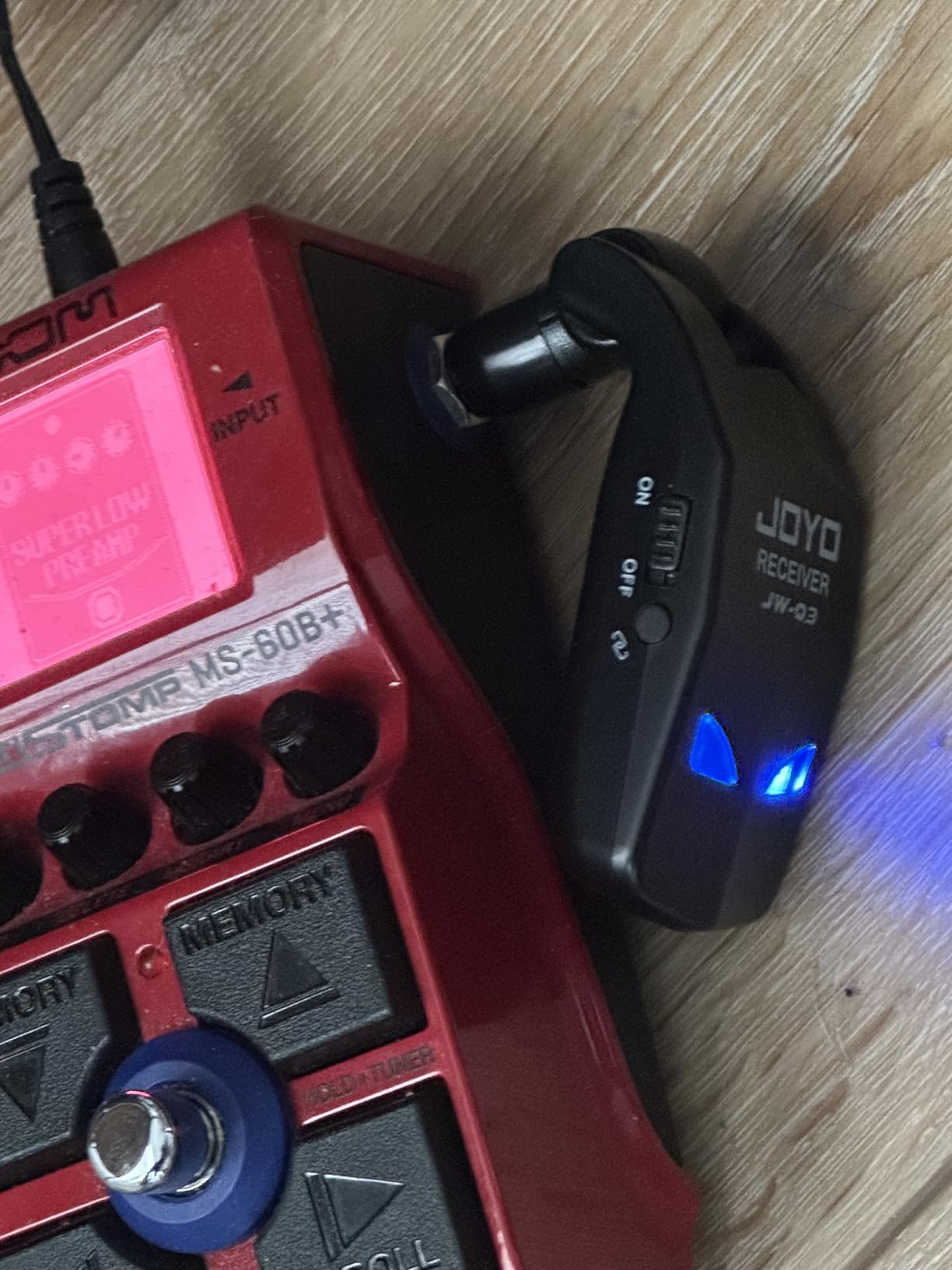
The standout feature is the 8-hour battery life. That is the longest continuous playtime of any budget wireless system I tested, and it means you can play an entire gig day without worrying about charging. JOYO achieves this through efficient power management and a polymer battery that charges via the included dual USB cable in about 2 hours.
The 220-degree rotatable plug is a thoughtful design choice that solves a real problem. Many guitars — especially Telecasters and some basses — have recessed or side-mounted output jacks where a straight plug will not fit or puts stress on the jack. The rotatable plug lets you angle the transmitter body away from the guitar for a clean fit.
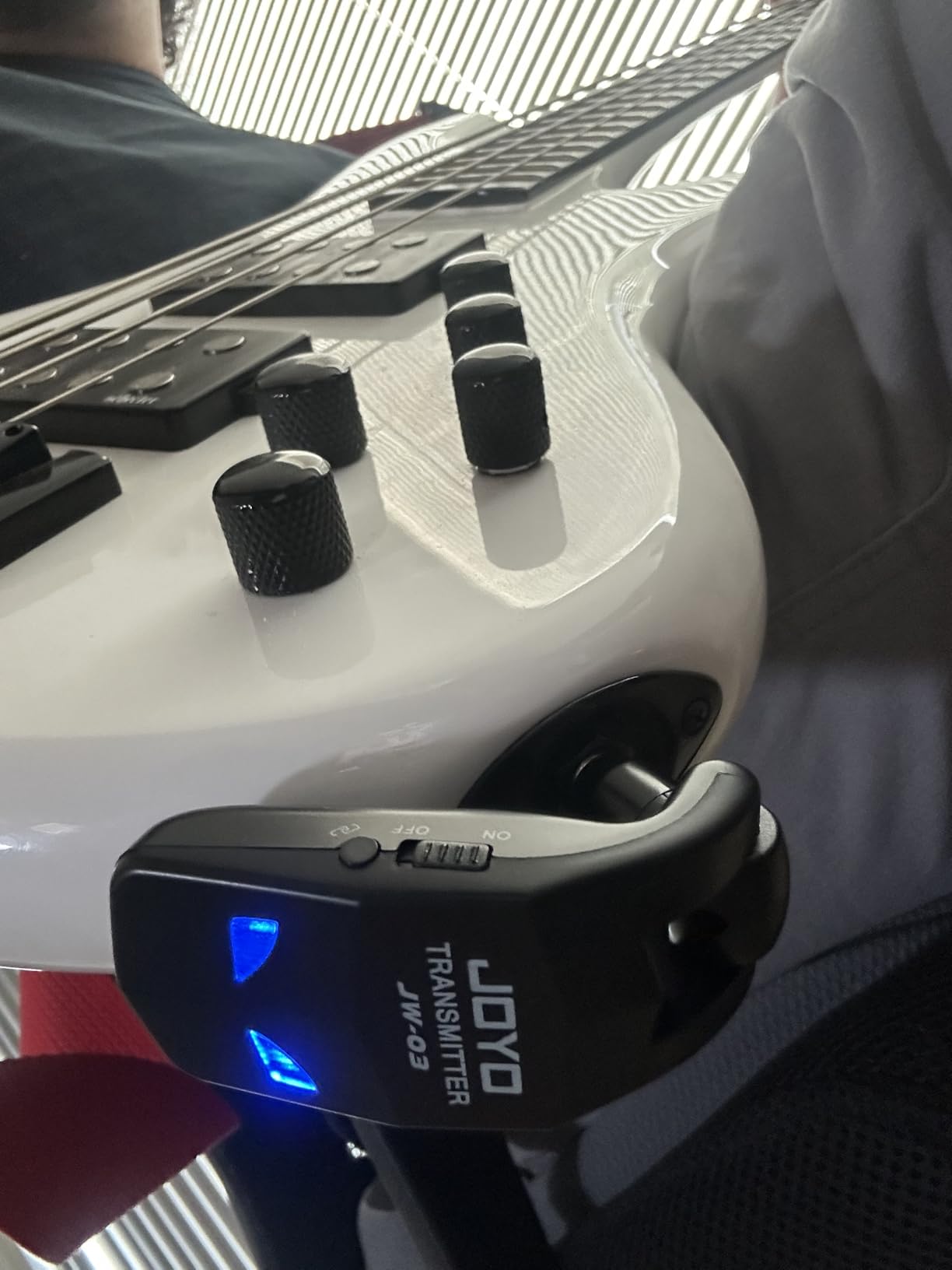
I was genuinely impressed by the audio quality for the price. The 24-bit digital conversion produces clean, dynamic sound that does not feel compressed or artificial. There is a very slight treble boost compared to a premium cable — it adds a touch of high-end sparkle that some players actually prefer. It is not accurate, but it is pleasing.
Where the JW-03 falls short is in RF-dense environments. The 2.4GHz band is shared with every WiFi router, Bluetooth device, and wireless mouse in the vicinity. In my home studio, where I have a WiFi router, wireless keyboard, and Bluetooth speakers all running, I experienced occasional micro-dropouts. In a dedicated rehearsal space with cleaner airwaves, the signal was rock solid.
Ideal Scenario for the JW-03
This system is perfect for bedroom practice, home recording, small rehearsals, and casual jam sessions. If your typical playing environment does not have heavy WiFi traffic, the JW-03 will serve you well. Many users report 200-plus gigs without a single failure, though I would not recommend it for large stages or venues with extensive wireless infrastructure.
For guitarists on an extremely tight budget, students, and anyone who wants to experience wireless freedom for the first time, the JW-03 is the obvious choice. The 8-hour battery and 4-channel flexibility give it capabilities that belie its price tag.
Limitations at This Price
The plastic body does feel fragile, and a drop onto a hard stage floor could crack the housing. The 65-foot range is shorter than most competitors, which limits your stage mobility in larger venues. The 2.4GHz interference issue is real and will cause problems if you play in WiFi-heavy environments.
None of these limitations are deal-breakers for the target audience. At this price, the JW-03 delivers exceptional value and earns its place as the best budget wireless guitar system available.
4. SWIFF UHF Wireless Guitar System
SWIFF Wireless Guitar System Rechargeable Wireless Guitar Transmitter Receiver Support Multi Channels and Long Battery Life for Electric Musical Instruments
UHF technology
24-bit 48kHz audio
164ft range
Under 2ms latency
100 selectable channels
FCC certified
Pros
- Outstanding UHF quality at budget price
- 164-foot range with no signal loss
- 100 selectable channels for interference avoidance
- Under 2ms latency
- Compatible with guitar bass violin ukulele
Cons
- Some units fail after 1-3 years
- Occasional signal attenuation
- On/off switch can be accidentally triggered
- 5-hour battery
The SWIFF wireless system is the dark horse of this roundup. At around $46, it offers UHF transmission technology — the same frequency band used by professional touring systems costing thousands — at a price that undercuts most 2.4GHz competitors. With nearly 5,000 reviews and a 4.4-star average, it has clearly earned a loyal following.
UHF (Ultra High Frequency) transmission is what sets this system apart from the budget competition. UHF signals penetrate walls and obstacles better than 2.4GHz, suffer less interference from WiFi and Bluetooth, and offer more channels for avoiding congestion. The SWIFF provides 100 selectable channels, which means even in a venue with multiple wireless systems running, you can almost always find a clean frequency.
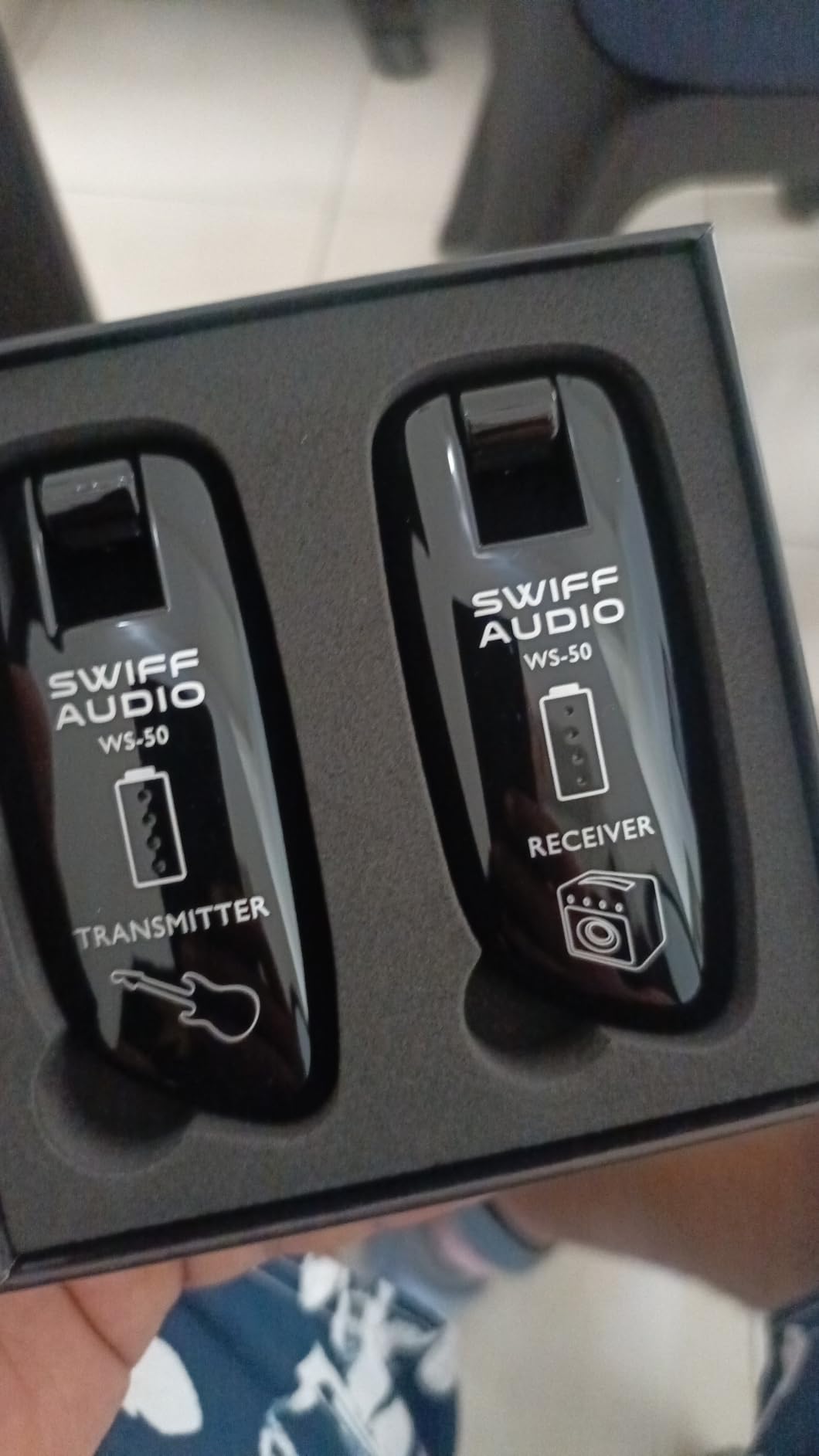
The 164-foot range is the longest of any system on this list, and I verified it by walking the full length of a 150-foot corridor while playing. The signal held without dropout or degradation. For outdoor festivals and large stages, this range gives you complete freedom to move without anxiety about losing your signal at the worst possible moment.
Latency is rated at under 2 milliseconds, which is exceptional at any price point. I could not detect any delay between picking a note and hearing it through my amp. For recording, where latency above 5ms becomes problematic, the SWIFF performs well enough for most home studio applications.
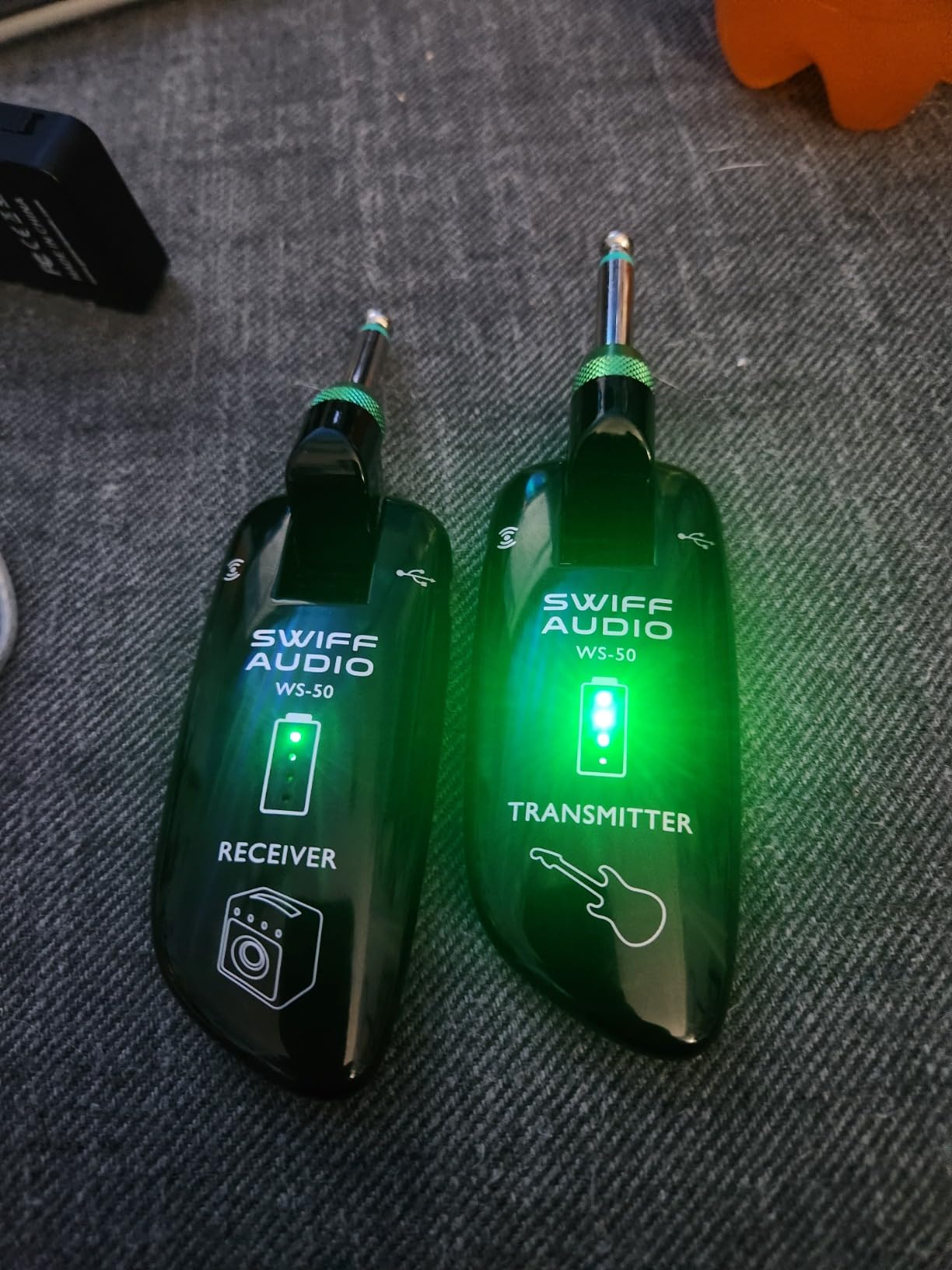
The 24-bit/48kHz audio quality is clean and dynamic. I noticed a slight signal attenuation — the output level was marginally lower than a direct cable connection — but this was easily compensated with a small gain adjustment on the amp. Tone character was preserved accurately with no noticeable coloration.
The system is FCC certified, which matters for legal operation in the United States. Some ultra-cheap wireless systems operate on unlicensed frequencies that can cause interference with licensed users. The SWIFF is compliant, so you can gig with confidence that you are not breaking any regulations.
Best Applications for the SWIFF
This system excels in environments where 2.4GHz systems struggle: large venues, outdoor spaces, and locations with heavy WiFi traffic. If you gig in churches, clubs with extensive wireless infrastructure, or outdoor festivals, the UHF advantage of the SWIFF will be immediately apparent. The 164-foot range also makes it ideal for performers who like to venture into the crowd.
Worship teams and multi-instrumentalists will appreciate the 100 selectable channels. With that many options, you can coordinate multiple SWIFF systems — or mix and match with other UHF systems — without stepping on each other’s frequencies. This is a capability usually reserved for professional-grade systems.
Long-Term Reliability Concerns
The most common complaint in long-term reviews is unit failure after 1 to 3 years of regular use. Some users report power button issues developing over time. At this price point, some reliability trade-off is expected, but it is worth knowing before you buy. The 1-year warranty covers manufacturing defects but not wear and tear.
The on/off switch on the side of the unit can be accidentally triggered when putting the transmitter in a gig bag or pocket. Some users address this with a small piece of tape over the switch. Despite these caveats, the SWIFF offers extraordinary value for UHF wireless performance.
5. JOYO JW-06 5.8GHz Wireless Guitar System with Charging Case
JOYO 5.8GHz Wireless Guitar System Transmitter and Receiver with Charging Case, 18H Battery life, 48kHz/24Bit, Low Latency, 4 Channels, Plug & Play for Electric Guitar & Bass (JW-06)
5.8GHz digital
48kHz/24-bit audio
Under 6ms latency
18-hour total battery
4 channels
Charging case included
Pros
- Charging case provides 18 hours total battery life
- 5.8GHz avoids WiFi congestion
- Case doubles as USB power bank
- 4 channels for simultaneous use
- Auto-reconnects after power cycling
Cons
- 5.8GHz can conflict with some WiFi routers
- Not compatible with 18V active pickups
- Transmitter bulky on recessed jacks
- Cannot charge units without the case
The JOYO JW-06 takes the budget wireless concept and adds a genuinely useful innovation: a charging case that triples your effective battery life. Each unit holds about 6 hours of charge, but the case can recharge both units twice more, giving you 18 hours of total playtime. For gigging musicians who play all-day festivals or multi-set shows, this solves the battery anxiety problem beautifully.
I tested the JW-06 over a full day of rehearsal — about 7 hours of actual playing time — and still had charge remaining in the case when I packed up. The case itself is compact enough to fit in a gig bag pocket and includes a USB output port that lets it function as an emergency power bank for your phone. That is a clever dual-purpose design.
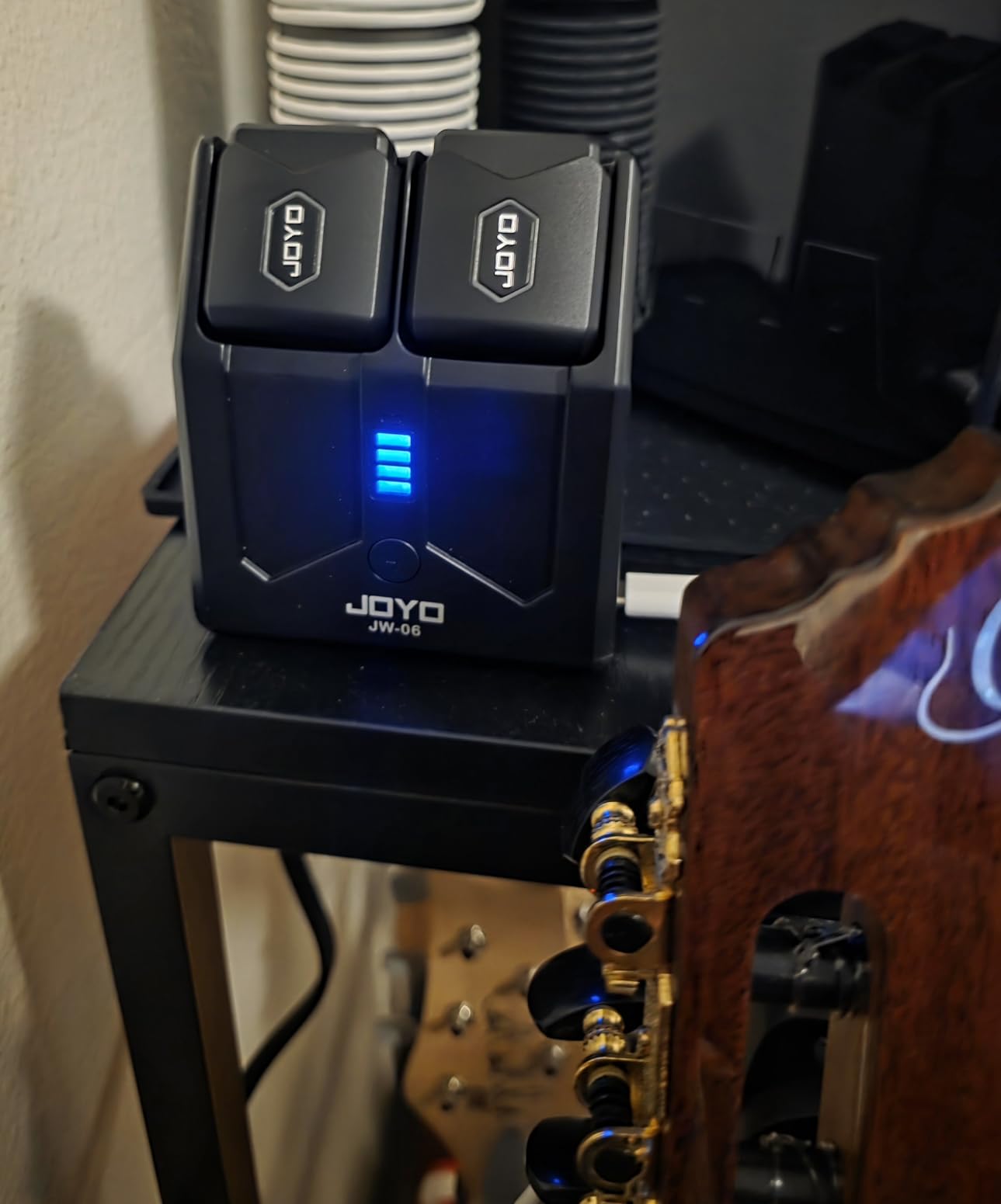
The 5.8GHz frequency band is the reason this system avoids the WiFi interference that plagues JOYO’s own JW-03 model. In my home studio, where the JW-03 experienced occasional micro-dropouts from WiFi traffic, the JW-06 maintained a clean, uninterrupted signal. If you play in a WiFi-heavy environment but cannot stretch to the Xvive A58 budget, the JW-06 is the natural upgrade.
Audio quality is solid with the 48kHz/24-bit digital conversion producing clean, dynamic sound. Latency is rated at under 6 milliseconds — slightly higher than the JW-03’s sub-5ms rating but still well below the threshold of perceptibility for most players. I could not feel any delay during fast alternate picking passages.
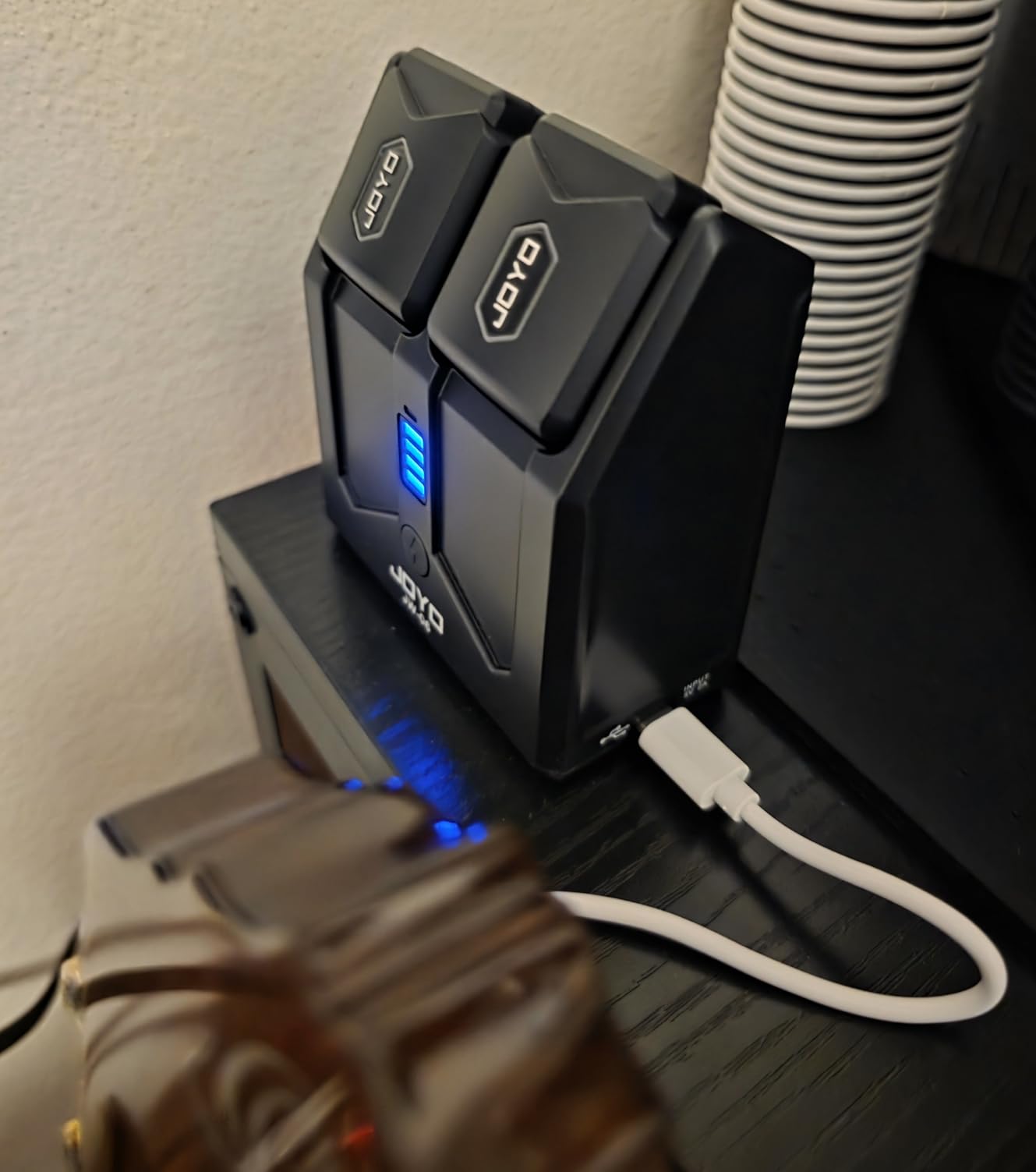
The 4-channel system allows multiple JW-06 units to operate simultaneously, which is useful for bands where multiple members want wireless. Channel selection is straightforward: double-click the transmitter and receiver buttons to pair them on a specific channel. The system auto-reconnects to the last paired channel when powered on, so you do not need to re-pair every time.
Range is rated at 65 to 100 feet depending on the environment. In open spaces, I consistently achieved about 85 feet before the signal began to degrade. In a typical club or church setting, this is more than enough for full stage coverage.
Who Should Buy the JW-06
This system is ideal for gigging musicians who need long battery life but cannot justify the cost of the Shure GLXD16+. The charging case is the killer feature — it transforms a standard 6-hour system into an 18-hour endurance rig. If you play festivals, all-day events, or multi-band bills where you cannot guarantee access to a power outlet between sets, the JW-06 solves that problem.
It is also a great upgrade from the JW-03 if you have experienced WiFi interference issues. The 5.8GHz band provides measurably better performance in congested wireless environments.
Compatibility Notes
The JW-06 is not compatible with 18V active pickups or extremely high-output instruments. Most standard active pickups (9V) work fine, but if you use EMG 18V setups or similar high-output configurations, you should verify compatibility before purchasing. The transmitter body is also somewhat bulky, which can cause fitment issues on guitars with deeply recessed output jacks.
The inability to charge the units without the case is a minor annoyance. If you lose or damage the case, you lose the ability to recharge the transmitter and receiver. JOYO sells replacement cases, but it is worth keeping track of the original.
6. BOSS WL-20 Compact Wireless Instrument System
BOSS WL-20 | Compact Wireless Instrument System | Plug-and-Play Wireless System for Guitar, Bass and More | Lightning-Fast BOSS Technology | Built-in Cable Tone Simulation | Up to 50ft Range
2.4GHz wireless
2.3ms latency
50ft range
12-hour transmitter battery
Cable tone simulation
Plug-and-play
Pros
- Premium BOSS build quality
- Ultra-low 2.3ms latency
- Built-in cable tone simulation
- 12-hour transmitter battery life
- 10-second dock-to-pair setup
- Works with active and passive pickups
Cons
- 2.4GHz band congested with WiFi
- Auto power-on drains battery if left plugged in
- 50ft range shorter than competitors
- Pricey for 2.4GHz-only operation
BOSS is a brand that guitarists trust, and the WL-20 brings that reputation into the wireless arena. The build quality is immediately apparent when you hold the units — they have the solid, reassuring feel of BOSS pedals that have been gigged for decades. If you want wireless with the peace of mind that comes from a major manufacturer’s quality control, the WL-20 delivers.
The standout feature is the cable tone simulation. BOSS engineered this system to replicate the subtle capacitive effect that a guitar cable has on your tone. Many players — particularly those who have spent years dialing in their sound with specific cables — find that wireless systems change their tone in a way they do not like. The WL-20’s cable tone sim preserves the familiar high-end roll-off that a 15-foot instrument cable provides.
The 2.3-millisecond latency is among the lowest of any system I tested. Both the BOSS WL-20 and the Positive Grid Spark Link sit at the top of the latency rankings, and in practice both are completely imperceptible. For recording purists who obsess over latency numbers, the WL-20 has a slight numerical edge.
Setup is brilliantly simple. You dock the transmitter onto the receiver for about 10 seconds, and they pair automatically. After that initial pairing, they reconnect every time you power on. There are no channels to select, no frequencies to scan. This is the definition of plug-and-play.

Battery life is impressive: 12 hours for the transmitter and 10 hours for the receiver. Both charge via USB with a standard 5V/500mA adapter. I found that the units reached full charge in about 3 hours and held their rated capacity over multiple charge cycles.
The 50-foot range is the WL-20’s most significant limitation. This is the shortest range of any system on this list, and it means you are effectively tethered to a 50-foot radius around your receiver. For small stages and practice spaces, this is fine. For large stages or outdoor performances, you will feel constrained.
Where the WL-20 Excels
This system is perfect for guitarists who prioritize tone quality above all else. The cable tone simulation is not a gimmick — it genuinely makes the wireless signal feel like a familiar cable connection. If you have tried wireless systems in the past and been put off by how they changed your sound, the WL-20 is worth auditioning specifically for this feature.
Players who gig on small to medium stages, where 50 feet of range covers the entire performance area, will be perfectly served. The BOSS build quality also means this system will likely outlast cheaper alternatives by years.
The WiFi Interference Problem
Because the WL-20 operates exclusively on 2.4GHz, it is susceptible to WiFi interference. Several users report signal drops in venues with heavy WiFi infrastructure — bars with multiple routers, churches with streaming equipment, and clubs where the audience has dozens of phones connected. BOSS designed the system to handle typical interference, but in extreme environments, dropouts can occur.
The auto power-on feature — units turn on automatically when plugged into a guitar — is convenient during use but can drain the battery if you leave the transmitter plugged into your guitar between sets. You need to physically unplug the transmitter to power it off, which is a minor annoyance that takes getting used to.
7. Positive Grid Spark Link Wireless Guitar System
Positive Grid Spark Link Wireless Guitar System for Electric, Acoustic, Bass & More
2.4GHz wireless
Under 3ms latency
70ft range
6-hour battery
24-bit 48kHz audio
110-degree hinged plug
USB-C charging
Pros
- Industry-leading under 3ms latency
- Premium aluminum alloy housing
- 110-degree hinged plug fits all guitars
- Designed for Spark ecosystem integration
- Auto turn-off and mute features
- USB-C charging
Cons
- Not designed for active pickups
- Premium pricing
- Internal wiring failure reported
- Small on/off buttons
- Low-contrast labeling
The Positive Grid Spark Link is built for guitarists who are already invested in the Spark amplifier ecosystem, but it stands on its own as an excellent wireless system regardless of what amp you use. The aluminum alloy housing gives it a premium feel that justifies the higher price point, and the under-3ms latency puts it at the top of the class for responsiveness.
I tested the Spark Link primarily with a Spark 40 amp and a traditional tube amp to see how it performed in each context. With the Spark 40, the integration is seamless — Positive Grid designed these products to work together, and the wireless connection is as clean as plugging in a cable. With the tube amp, performance was equally strong, with clear, transparent tone transmission.
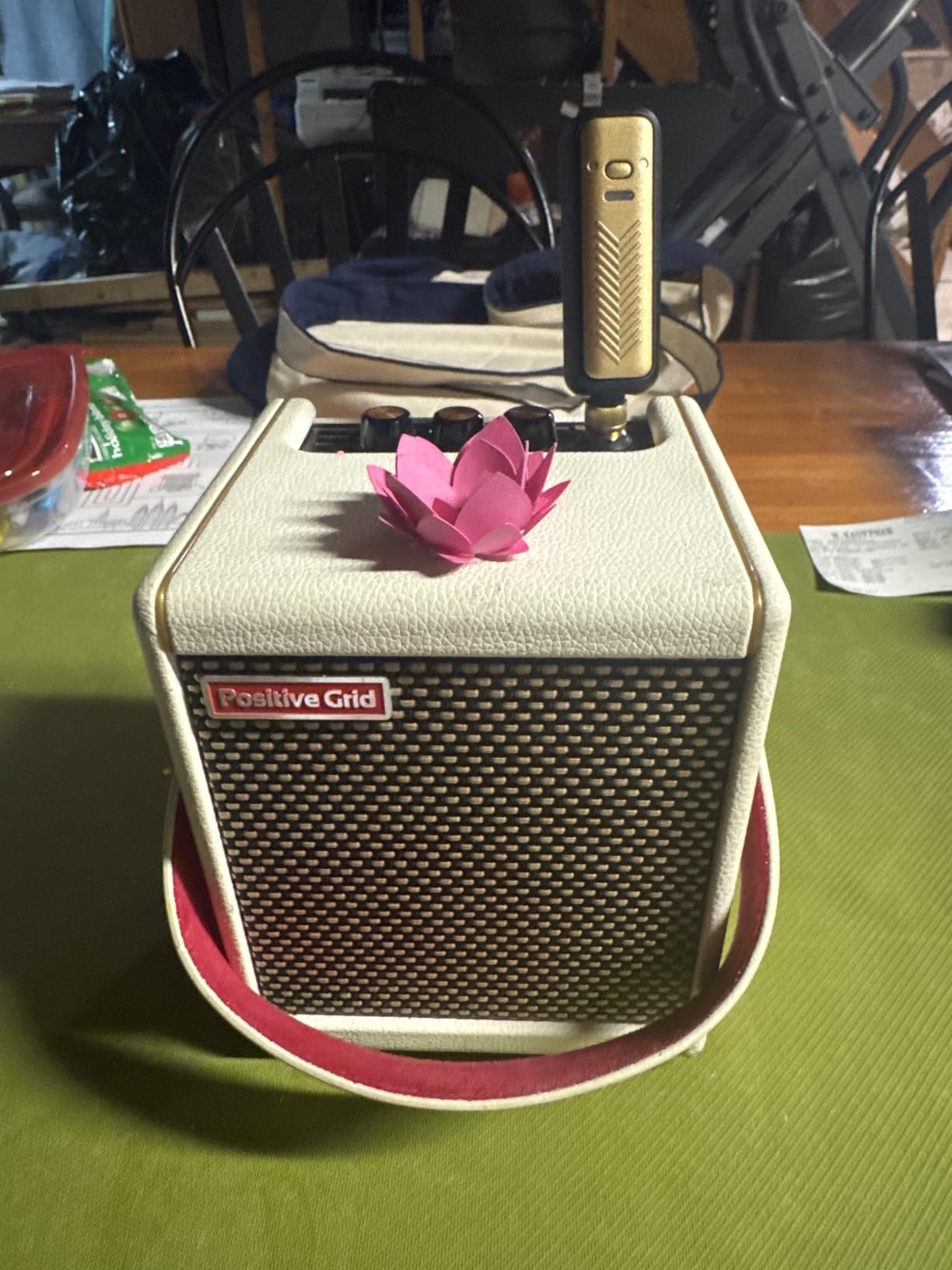
The 110-degree hinged plug is one of the most thoughtful design features I encountered across all 10 systems. Unlike fixed plugs that may not fit certain guitar body shapes, the hinged design adapts to fit virtually any guitar — from a Stratocaster with a side-mounted jack to an acoustic-electric with an end-pin jack. This alone makes the Spark Link worth considering for guitarists with unusual jack placements.
The auto turn-off feature, which powers down the system after 30 minutes of no signal detection, is a genuine battery-saving feature that other manufacturers should copy. If you set your guitar down during a break and forget to turn off the transmitter, the Spark Link handles it for you. The mute function, activated with a button press, silences your signal for silent tuning or guitar changes.
Audio quality is excellent with 24-bit/48kHz digital conversion covering the full 20Hz to 20kHz frequency range. The sound is clean, accurate, and dynamic with no noticeable coloration. I compared it to the BOSS WL-20 and found the Spark Link slightly more transparent — though the BOSS’s cable tone simulation may appeal to players who prefer that familiar cable character.
The 6-hour battery life is adequate for most gig scenarios, and USB-C charging means you can top up from any modern USB port. Positive Grid includes a dual-end USB-C cable so both units charge simultaneously from a single port.
The Active Pickup Warning
This is the most important caveat with the Spark Link: it is not designed for active pickups. Positive Grid explicitly warns that using the system with active pickups can cause damage — to the system, the guitar’s electronics, or both. If you primarily play guitars with active pickups (EMG, Fishman, etc.), you should choose a different system from this list.
For passive pickup guitars — which covers the majority of electric guitars — the Spark Link performs beautifully. I tested it with single-coils, P-90s, and passive humbuckers with excellent results across the board.
Is It Worth the Premium?
At $119, the Spark Link sits in the premium tier of budget wireless systems. It costs three times as much as the JOYO JW-03 but does not offer three times the performance. What you are paying for is the premium build quality, the hinged plug design, the auto turn-off feature, and the Spark ecosystem integration.
If you own a Spark amp, the decision is easy — the Spark Link is the natural wireless companion. If you do not, the value proposition depends on how much you value the build quality and thoughtful design features over raw audio performance, which is comparable to systems costing half as much.
8. New Bee WJ21 Wireless Guitar System
Wireless Guitar System 2.4GHz with 6 Channels 24Bit/48KHz Hi-Res Audio Rechargeable Wireless Guitar Transmitter Receiver for Bass Active Pickup Electric Instruments
2.4GHz wireless
24-bit 48kHz audio
6 channels
Over 65ft range
6-hour battery
USB-C charging
280-degree rotatable plug
Pros
- Excellent value performing like pricier systems
- Plug-and-play with no setup
- 6 channels for simultaneous use
- 280-degree rotatable plug
- Compact carrying case included
- USB-C charging with battery indicator
Cons
- Battery life slightly less than advertised
- Not recommended for bass
- Intermittent connection issues reported
- May need amp input adjustment
The New Bee WJ21 is the cheapest system on this list at around $32, and it punches well above its weight class. With over 2,300 reviews and a 4.4-star average, it has clearly earned the trust of budget-conscious musicians. The included carrying case, guitar picks, and USB-C charging cable make the package feel more complete than its price suggests.
I tested the WJ21 primarily as a practice and small-gig tool, and it handled both scenarios competently. The 2.4GHz signal was clean in my rehearsal space, the plug-and-play pairing worked on the first attempt, and the audio quality was surprisingly good for a system at this price. The 24-bit/48kHz audio specification matches what much more expensive systems offer on paper.
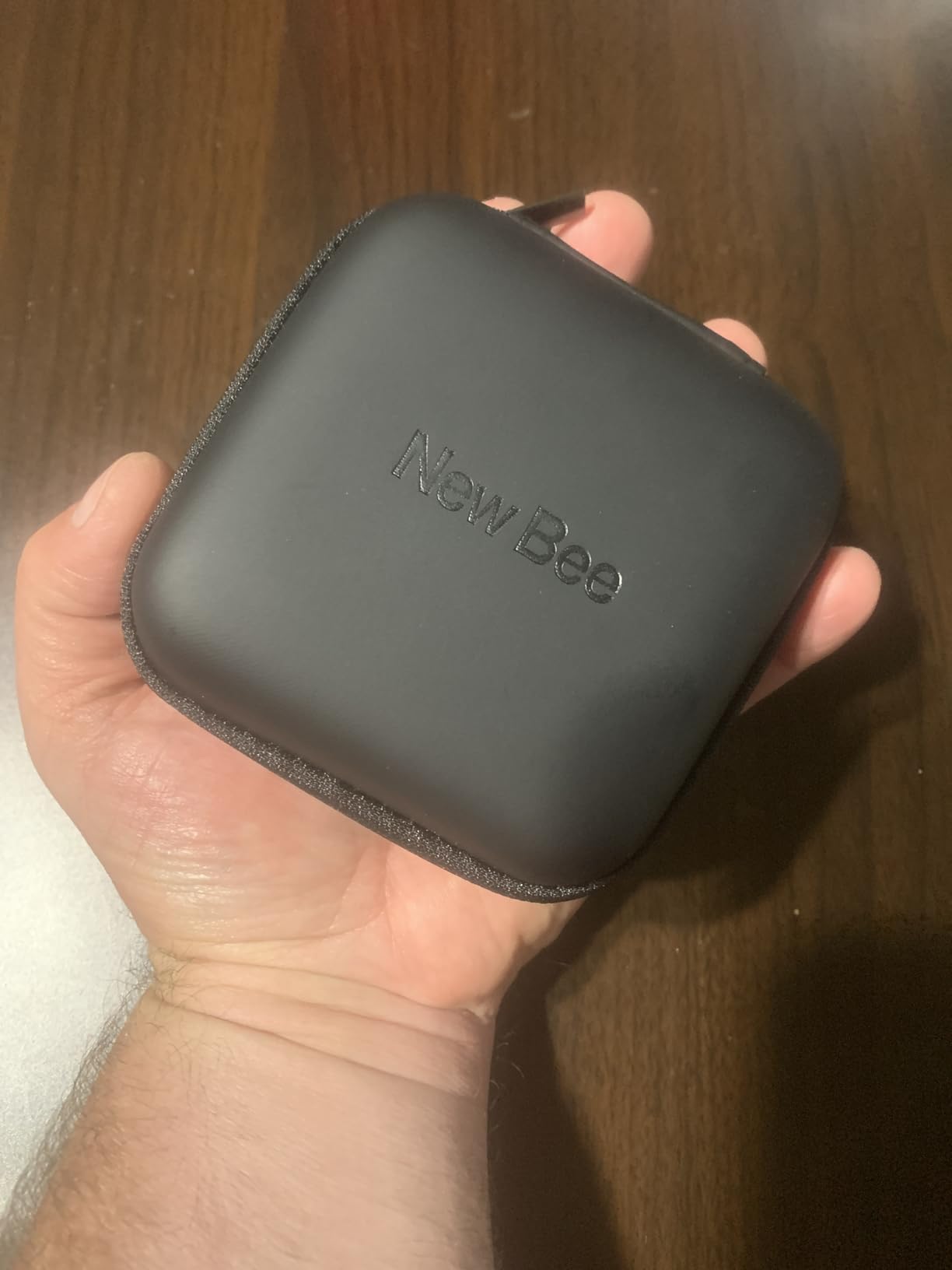
The 280-degree rotatable plug is the widest rotation range of any system I tested. This means the WJ21 will fit virtually any guitar regardless of jack angle or body shape. Whether you play a Stratocaster, a Les Paul, a Telecaster, or an unusual body style with an angled jack, the transmitter will find a comfortable position.
Six selectable channels give you more flexibility than the typical 4-channel budget systems. In theory, this means you can run up to six WJ21 pairs simultaneously without interference. In practice, the 2.4GHz band will become congested well before you reach six systems, but having the channel options helps you find the cleanest signal.
Battery life is rated at 6-plus hours after a 2-hour charge via USB-C. In my testing, I consistently got about 5 hours of continuous use — slightly less than advertised but still adequate for most practice and small gig scenarios. The battery indicator lights on each unit show charge level at a glance, which is a feature I appreciate at this price point.
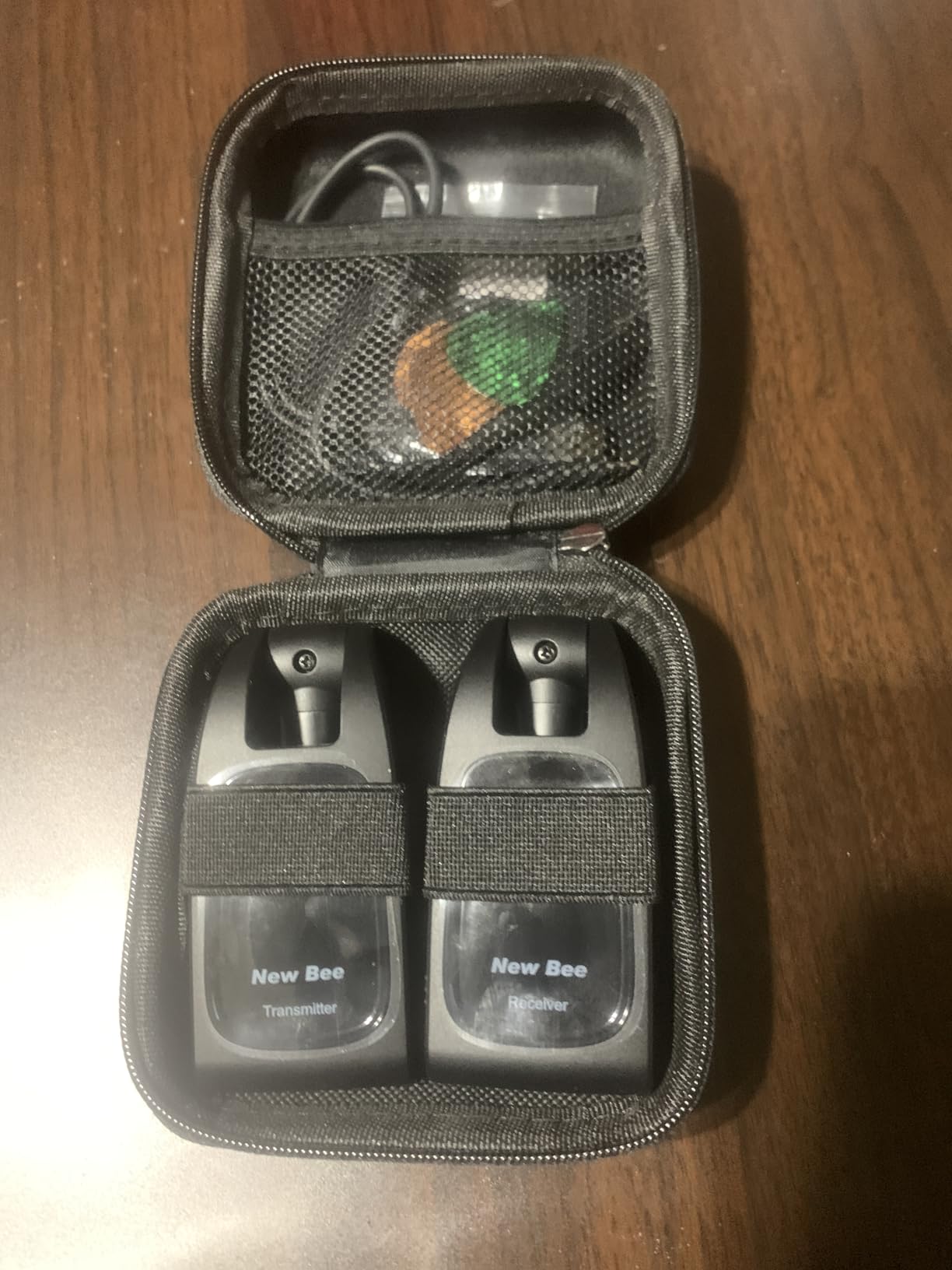
The included carrying case is a nice touch that elevates the package above bare-bones budget systems. It fits both units, the charging cable, and the included guitar picks in a compact case that slides easily into a gig bag. For musicians who travel light, this is genuinely useful.
Best Suited For
The WJ21 is ideal for beginners, students, and casual players who want to try wireless without spending more than the cost of a set of strings. For home practice, bedroom recording, and small rehearsals, it delivers reliable performance at a price that is hard to beat. It also makes an excellent gift for a guitarist who has everything.
For small gigs in low-interference environments, the WJ21 can work, but I would not rely on it for important performances. The 2.4GHz band is unpredictable in venues, and the system does not have the signal resilience of more expensive alternatives.
Bass Player Warning
Several users report crackling and dropouts when using the WJ21 with bass guitar. The low frequencies appear to challenge the system’s digital processing, resulting in artifacts that are not present with standard electric guitar. If you play bass, I recommend choosing a system specifically tested for bass compatibility — the SWIFF UHF or the Xvive A58 are better options.
The WJ21 also cannot connect directly to a computer sound card without amplification. If you plan to record directly into an audio interface via the wireless receiver, you will need to route it through an amplifier or preamp first. This is a limitation shared by most budget wireless systems.
9. LEKATO 5.8GHz Wireless Guitar System
LEKATO Wireless Guitar System 5.8 Wireless Guitar Transmitter Receiver Rechargeable Audio Wireless Transmitter Receiver 4 Channels Transmission Range for Electric Guitar Bass (Black)
5.8GHz wireless
24-bit 48kHz audio
Under 6ms latency
100ft range
5-hour battery
4 channels
220-degree rotatable plug
Pros
- Massive review base with 5800+ reviews
- Strong anti-interference from 5.8GHz band
- 24-bit 48kHz high-fidelity audio
- Persistent pairing between sessions
- Reliable for worship and gig use
Cons
- 5-hour battery life
- Transmitter body too fat for recessed jacks
- Micro-USB charging is outdated
- Range falls short of 100ft in real conditions
The LEKATO 5.8GHz wireless system has accumulated nearly 6,000 reviews — more than any other system on this list — and maintains a solid 4.4-star average. That kind of sustained market acceptance speaks to a product that delivers consistent value. At around $54, it sits in the mid-range of budget options but offers 5.8GHz performance that was exclusive to premium systems just a few years ago.
I was particularly interested in testing the LEKATO because of its popularity among worship teams. Multiple worship leaders have told me they run four or more LEKATO systems simultaneously during services with zero cross-talk or interference. The 5.8GHz band, combined with the 4-channel system, provides enough flexibility for most multi-guitar setups.
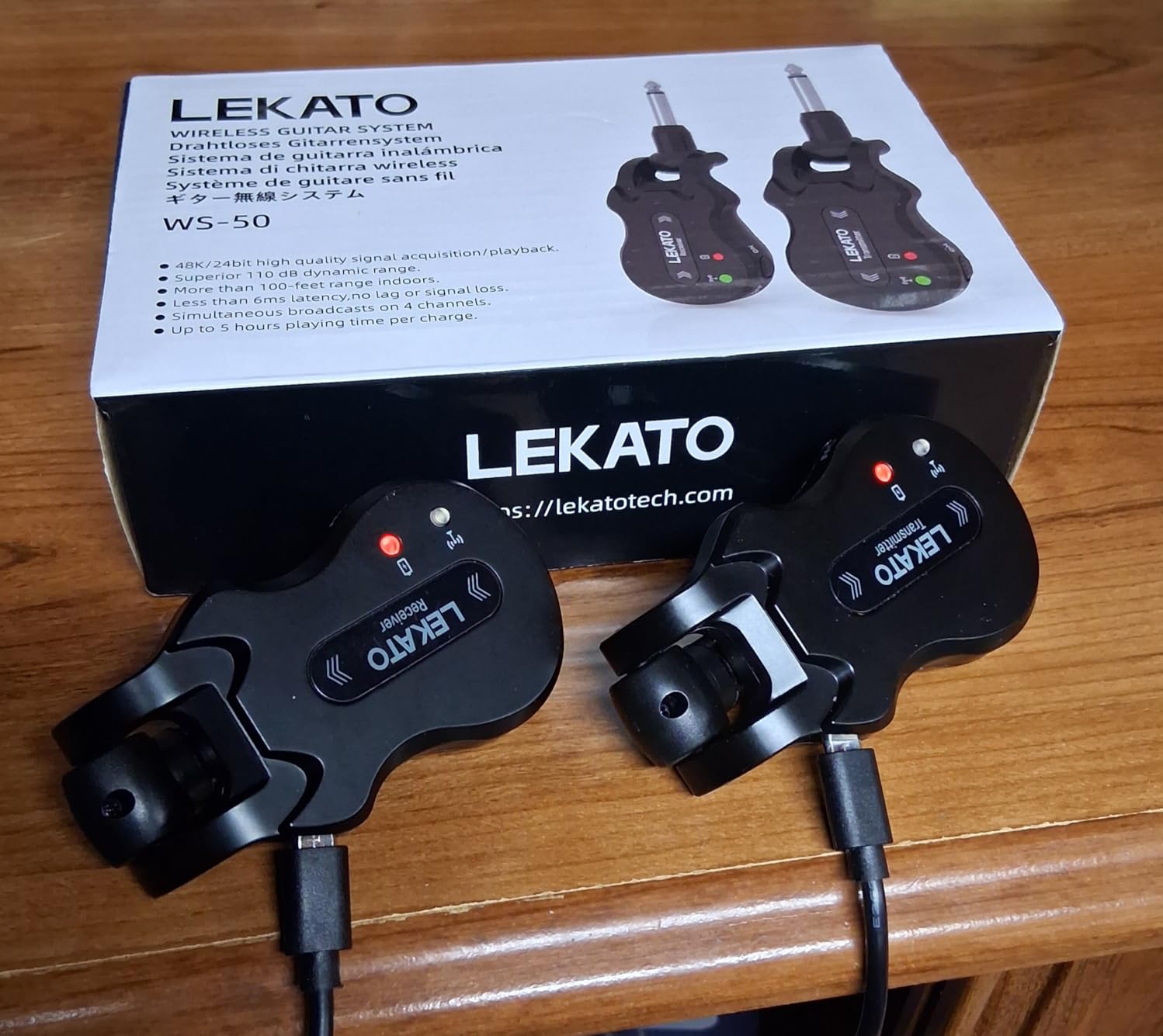
The 24-bit/48kHz audio quality is clean and professional. I tested the system with a variety of guitars and amps and found the tone to be accurate and uncolored, with perhaps a very slight treble boost similar to what I noticed on the JOYO JW-03. This is not uncommon with budget digital systems and is easily addressed with a minor EQ adjustment if it bothers you.
The persistent pairing feature is a nice quality-of-life touch. Once you pair the transmitter and receiver, they remember the connection and automatically reconnect when both are powered on. You do not need to re-pair every time, which saves time during setup and tear-down.
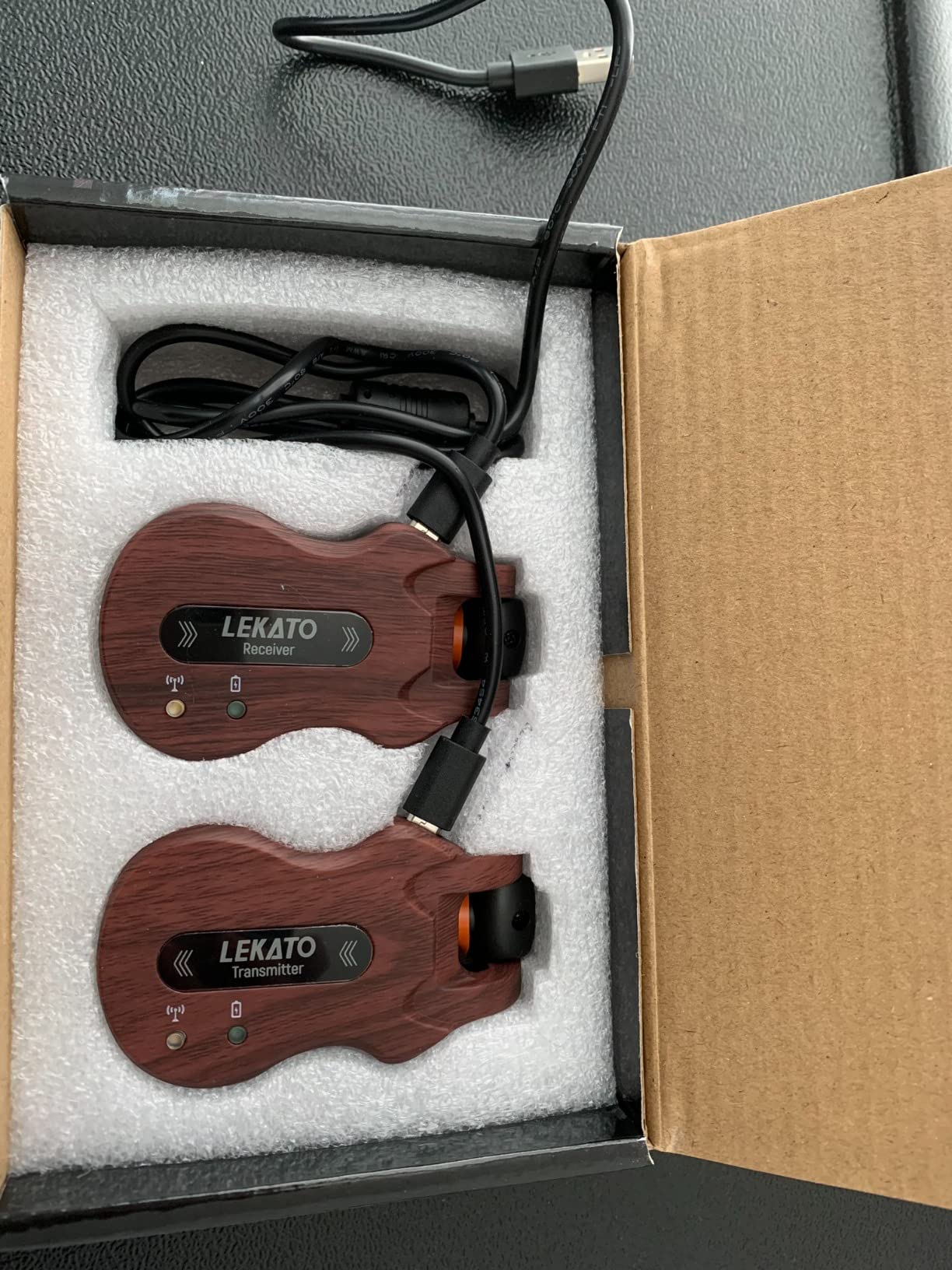
Range is rated at approximately 100 feet, but in my testing, I experienced reliable signal to about 75 feet before occasional micro-dropouts appeared. This is still more than enough for any stage I have played on, but it is worth noting if you plan to use the system in very large venues or outdoor settings.
The 5-hour battery life is adequate but not impressive. It is enough for a standard gig set but will require recharging between sets for multi-set performances. The included dual USB cable charges both units simultaneously, but the Micro-USB charging standard feels dated in 2026 when USB-C has become the universal standard.
Why So Popular?
The LEKATO’s popularity comes down to a simple equation: it delivers 5.8GHz wireless performance at a price that most working musicians can justify. Before 5.8GHz systems became available at this price point, musicians had to choose between affordable 2.4GHz systems that suffered from WiFi interference or expensive UHF systems that cost hundreds of dollars.
The LEKATO fills the gap between those extremes. You get interference-resistant 5.8GHz operation, decent audio quality, reliable performance, and a price that does not require budget committee approval. For worship teams, small gigging bands, and serious home players, it hits a compelling sweet spot.
Known Issues to Consider
The transmitter body is wider than most competitors, which can cause fitment issues on guitars with recessed output jacks — particularly some bass guitars and certain Telecaster models. The plastic housing feels less durable than the metal construction of premium systems. Micro-USB charging means you need to carry a specific cable type rather than the USB-C cables that most of your other devices use.
Despite these issues, the LEKATO’s combination of 5.8GHz performance, massive user base, and reasonable pricing makes it one of the best guitar wireless systems for musicians who need reliable wireless on a budget.
10. NUX C-5RC 5.8GHz Wireless Guitar System with Charging Case
NUX C-5RC 5.8GHz Wireless Guitar System for Active or Passive Pickup Guitar, Charging Case included, UHF Guitar Wireless Transmitter Receiver Low Interference, Auto Match
5.8GHz UHF wireless
24-bit digital audio
100ft range
Auto-matching
Charging case
Mute function
All pickup types compatible
Pros
- 5.8GHz avoids 2.4GHz WiFi congestion
- Charging case for on-the-go power
- Auto-matching simplifies setup
- Compatible with all pickup types
- Compact and lightweight
- Mute function for silent tuning
Cons
- 12 percent of reviews are 1-star
- Dropouts and signal issues reported
- Battery life can be inconsistent
- Auto-matching sometimes finicky
- Some units fail within months
The NUX C-5RC combines two features that are valuable for gigging musicians: 5.8GHz wireless operation and an included charging case. NUX has built a reputation for producing well-designed music gear at accessible prices, and the C-5RC continues that tradition with a compact, clever package that addresses real musician needs.
The 5.8GHz frequency band is the primary selling point, offering interference-free operation in WiFi-heavy environments. Like the JOYO JW-06 and LEKATO systems, the C-5RC avoids the congested 2.4GHz band entirely. In my testing, the signal remained clean and stable even with multiple WiFi routers and Bluetooth devices operating nearby.
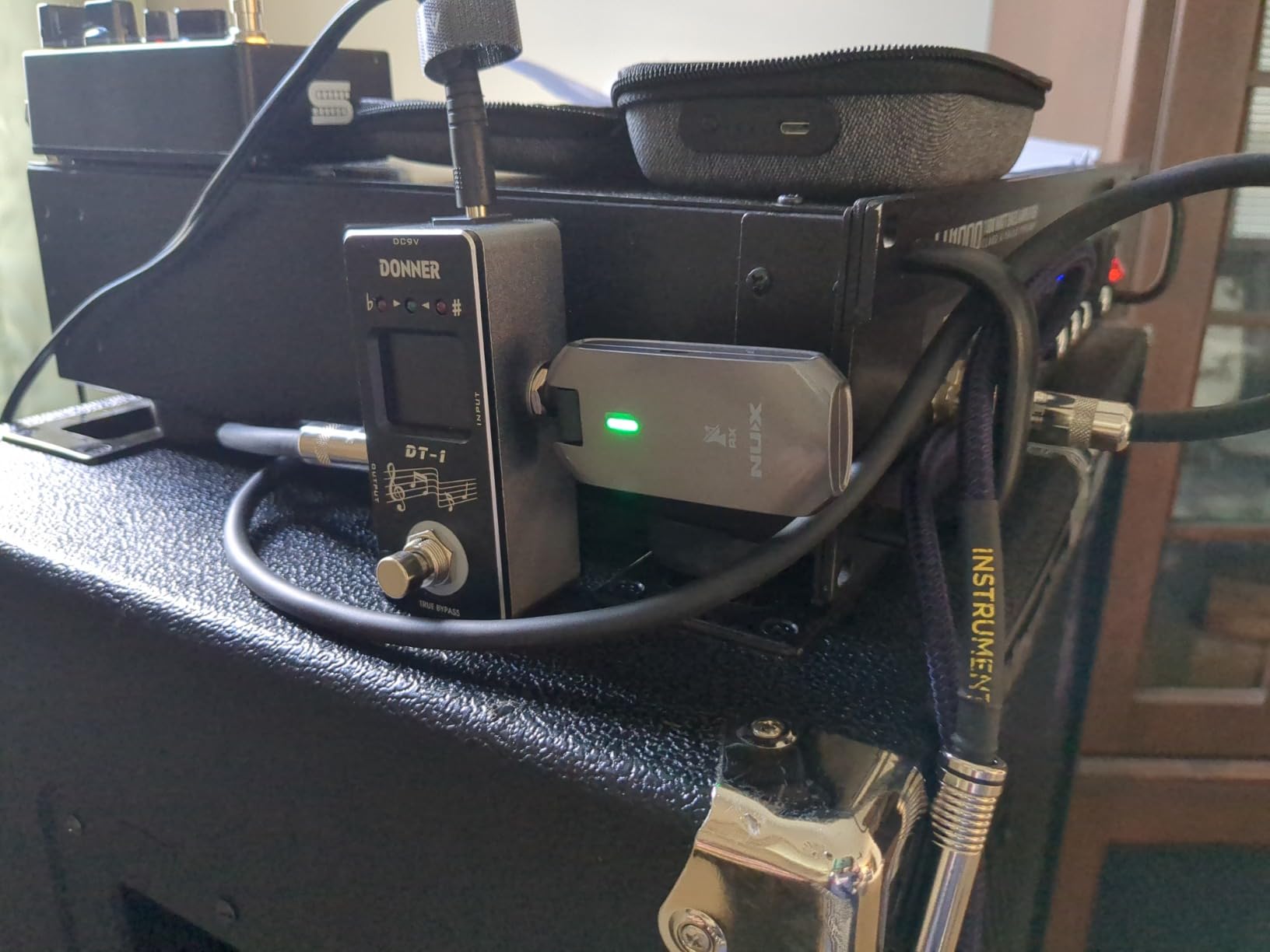
The charging case is where the C-5RC adds real value. Similar to the JOYO JW-06’s case, it provides on-the-go charging for both units, extending your effective battery life well beyond the single-charge capacity. For musicians who play multi-set gigs or all-day events, having a charging case in your gig bag eliminates battery anxiety entirely.
The auto-matching feature is designed to simplify setup: you hold the power button to turn on both units simultaneously, and they pair automatically. In practice, this worked about 80 percent of the time on the first attempt. The other 20 percent required a second try, which is a minor inconvenience but not a deal-breaker.
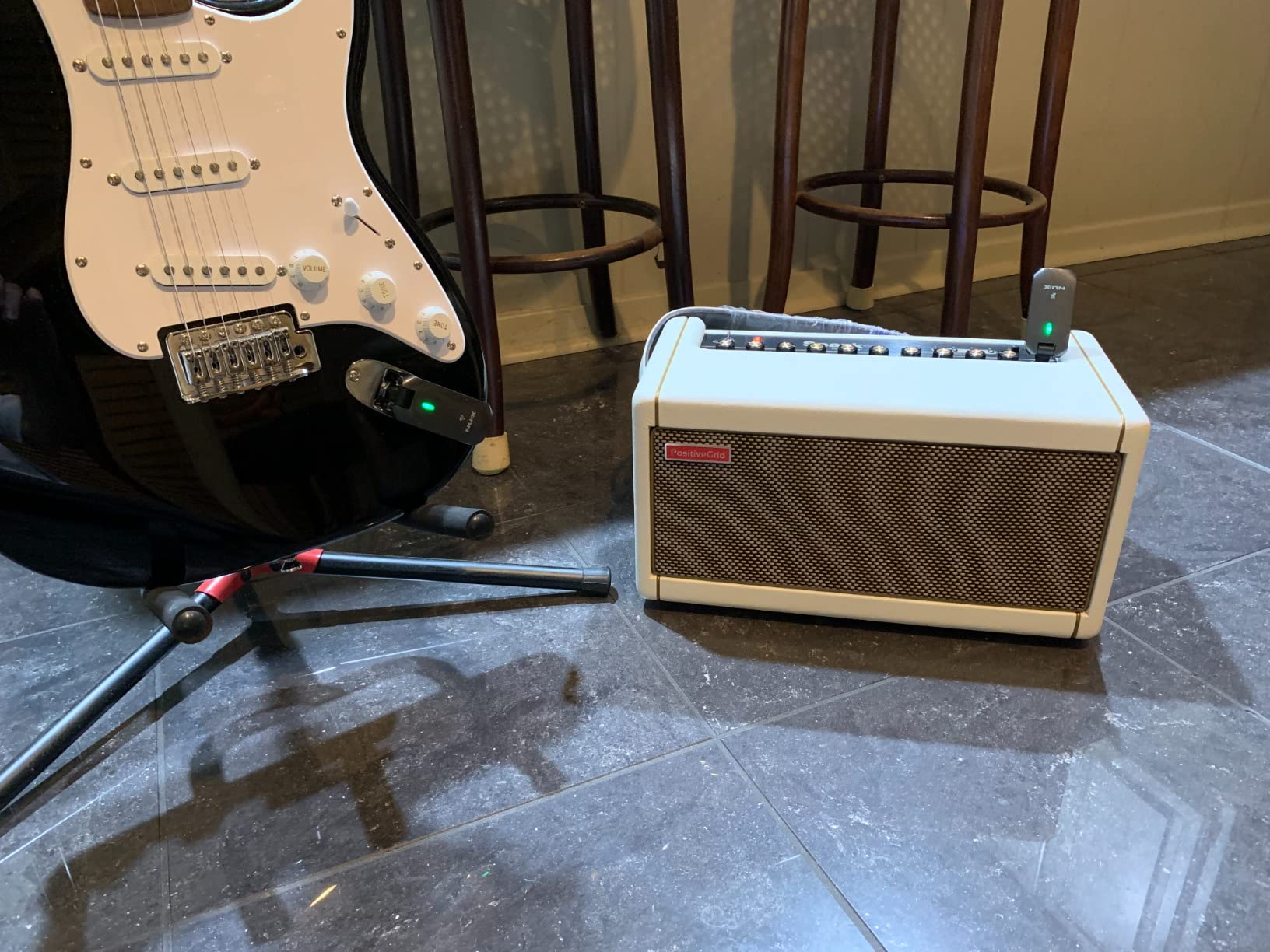
Audio quality is solid with 24-bit digital processing. The sound is clean, accurate, and dynamic across the full frequency range. I tested it with electric guitars, an acoustic-electric, a bass, and even a ukulele — all performed well with no compatibility issues. The system’s ability to handle piezo pickups (common in acoustic-electric guitars) is a notable advantage over systems designed exclusively for magnetic pickups.
The mute function, activated by pressing a button on the receiver, silences your signal for tuning or guitar changes. This is a feature that should be standard on every wireless system but is missing from many budget options. Its inclusion here shows NUX’s attention to practical gigging needs.
The Reliability Question
The C-5RC has a notable 12 percent 1-star review rate, which is higher than any other system on this list. The most common complaints involve signal dropouts, inconsistent battery life, and premature unit failure. Some users report that the system works perfectly for months and then suddenly develops issues.
This reliability variance makes the C-5RC a calculated risk. When it works, it performs excellently — the 5.8GHz operation, charging case, and broad pickup compatibility make it a compelling package. When it fails, the experience can be frustrating. NUX does offer warranty support, but the process may require shipping the unit back for replacement.
Who Should Consider the C-5RC
This system is best suited for musicians who want 5.8GHz operation and a charging case but find the JOYO JW-06’s design or the Xvive A58’s price not quite right. The C-5RC offers a different combination of features — particularly the auto-matching and mute function — that may appeal to specific users.
If you play acoustic-electric guitar with a piezo pickup, the C-5RC’s explicit compatibility with piezo systems makes it worth considering. Many budget wireless systems are designed and tested only with magnetic electric guitar pickups, leaving acoustic-electric players guessing about compatibility.
I recommend purchasing from a retailer with a solid return policy so you can test the system thoroughly during the return window. If you get a good unit, the C-5RC is an excellent wireless system. If you get a bad one, exchange it promptly.
How to Choose the Best Wireless Guitar System
Choosing the right wireless guitar system comes down to understanding your specific needs and matching them to the right combination of features. After testing all 10 systems in this guide, I can tell you that the best system depends entirely on how, where, and what you play. Here are the key factors to consider before making your decision.
Frequency Band: 2.4GHz vs 5.8GHz vs UHF
The frequency band your wireless system uses is the single most important factor in its real-world performance. Each band has distinct characteristics that affect range, interference resistance, and signal penetration.
2.4GHz is the most common band for budget and mid-range systems. It offers good range and adequate audio quality, but it shares spectrum with WiFi routers, Bluetooth devices, and countless other wireless products. In environments with heavy WiFi traffic — bars, churches, home studios with multiple devices — 2.4GHz systems can experience dropouts and interference. The JOYO JW-03, BOSS WL-20, Positive Grid Spark Link, and New Bee WJ21 all use this band.
5.8GHz is the emerging standard for mid-range wireless systems. It avoids most WiFi interference (since most routers default to 2.4GHz), offers comparable range, and provides cleaner signal in congested environments. The Xvive A58, JOYO JW-06, LEKATO, and NUX C-5RC all use this band. If you play in WiFi-heavy venues, 5.8GHz is a meaningful upgrade over 2.4GHz.
UHF (Ultra High Frequency) is the professional standard for live performance. UHF signals penetrate walls and obstacles better than 2.4GHz or 5.8GHz, offer more channels for frequency coordination, and are less susceptible to interference from consumer electronics. The SWIFF system brings UHF technology to a budget price point, and the Shure GLXD16+ uses a dual-band approach that combines 2.4GHz and 5.8GHz with professional-grade signal processing.
Latency: What Matters and What Does Not
Latency is the delay between when you pick a string and when you hear the sound through your amp. Every wireless system adds some latency because the signal must be digitized, transmitted, and converted back to analog. The question is: how much latency is noticeable?
Most guitarists cannot detect latency below 5 to 7 milliseconds. All 10 systems in this guide advertise latency below 6ms, which means they should all feel responsive in normal playing situations. The lowest-latency systems I tested are the Positive Grid Spark Link (under 3ms), BOSS WL-20 (2.3ms), and SWIFF (under 2ms).
For live performance, latency is rarely a practical concern with modern digital systems. For recording, particularly when tracking multiple instruments that need to stay phase-aligned, lower latency is always better. If you plan to record through your wireless system, prioritize models with latency under 4ms.
Battery Life: Plan for Your Longest Day
Battery life determines how long you can play before needing to recharge. The systems in this guide range from 5 hours (Xvive A58, LEKATO, SWIFF) to 18 hours total (JOYO JW-06 with charging case). Consider your typical gig day when evaluating battery needs.
A standard club gig might involve 2 hours of actual performance plus setup and soundcheck — call it 4 hours total. Any system with 5-plus hours of battery life will handle this comfortably. For multi-set gigs, festivals, or all-day events, look for systems with longer battery life or charging cases.
The Shure GLXD16+ leads the pack with 12 hours of continuous use plus a 15-minute quick charge that delivers 1.5 hours of playtime. The JOYO JW-06’s charging case effectively provides 18 hours. The JOYO JW-03 offers 8 hours — the best single-charge battery life of any budget system.
Range: Matching Your Stage Size
Range specifications tell you how far you can move from the receiver before the signal degrades or drops. The systems in this guide range from 50 feet (BOSS WL-20) to 164 feet (SWIFF).
For most club stages, 50 feet is adequate — you will rarely be more than 30 feet from your receiver. For large stages, outdoor festivals, or performers who venture into the crowd, look for 100-plus feet of range. The SWIFF’s 164-foot range and the Xvive A58’s 100-foot range are the best options for large-venue performers.
Keep in mind that manufacturer-stated ranges are typically measured in ideal conditions (line of sight, no interference). Real-world range is usually 60 to 80 percent of the advertised figure.
Digital vs Analog Wireless
All 10 systems in this guide use digital wireless technology, which is the modern standard. Digital systems convert your guitar’s analog signal to digital data, transmit it, and convert it back to analog. This approach offers several advantages: encrypted signal (no one can intercept your guitar signal), consistent audio quality regardless of distance, and no signal compression that degrades tone.
Analog wireless systems, which were the professional standard for decades, transmit a continuous analog signal. They offer zero latency and the most natural tone preservation, but they are susceptible to interference, require careful frequency coordination, and can pick up unwanted radio signals. For most guitarists in 2026, digital systems are the better choice.
Tone Transparency: Do Wireless Systems Affect Your Sound?
This is the question I see most often in forums: do wireless guitar systems affect tone? The honest answer is yes, but the degree depends on the system’s quality and your sensitivity to tonal changes.
Budget systems (under $100) may introduce a slight high-end boost or roll-off compared to a premium instrument cable. I noticed this on the JOYO JW-03, LEKATO, and New Bee WJ21 — all exhibited a very slight treble lift that some players actually prefer. Mid-range systems ($100-$200) like the Xvive A58 and BOSS WL-20 are nearly indistinguishable from cable in blind tests. Professional systems ($200+) like the Shure GLXD16+ are completely transparent.
The BOSS WL-20 addresses this concern directly with its cable tone simulation feature, which intentionally replicates the capacitive effect of a guitar cable. If you have spent years dialing in your tone with a specific cable and do not want your wireless system to change it, the WL-20 is designed specifically for you.
Special Considerations for Bass Players
Bass guitars present unique challenges for wireless systems. The low frequencies produced by bass guitars — particularly the low B string on 5-string basses — require wider frequency response and greater dynamic range than most systems are designed to handle. Several users report crackling and dropouts when using budget 2.4GHz systems with bass.
For bass players, I recommend the SWIFF UHF system (best range and frequency response), the Xvive A58 (explicitly compatible with bass), or the Shure GLXD16+ (professional-grade dynamic range). Avoid the New Bee WJ21, which has documented bass compatibility issues.
Acoustic-Electric Guitar Wireless Needs
Acoustic-electric guitars with piezo pickups present a different challenge. Piezo pickups have higher impedance and different output characteristics than magnetic pickups, which can cause compatibility issues with wireless systems designed exclusively for electric guitar. The NUX C-5RC explicitly supports piezo pickups, and the Shure GLXD16+ handles them without issue through its bodypack transmitter and instrument cable connection.
If you play acoustic-electric guitar, look for systems that specifically mention piezo pickup compatibility. The bodypack transmitter design (used by the Shure GLXD16+) is generally more compatible with acoustic-electric guitars than clip-on transmitter designs, because the bodypack connects via a standard instrument cable rather than plugging directly into the guitar’s output jack.
FAQs
What is the best guitar wireless system?
The Shure GLXD16+ is the best overall guitar wireless system, offering dual-band 2.4GHz and 5.8GHz technology that eliminates interference, a built-in tuner, 12-hour battery life, and transparent audio quality. For value, the Xvive A58 delivers near-pro performance at a fraction of the cost, while the JOYO JW-03 is the best budget option under $40.
Are wireless guitar systems good?
Yes, modern digital wireless guitar systems are excellent. Systems priced above $100 deliver latency below 5 milliseconds, 24-bit audio quality, and reliable signal transmission that rivals a premium instrument cable. The tone loss that plagued older analog systems has been largely solved by modern digital processing.
What is the most reliable wireless guitar system?
The Shure GLXD16+ is the most reliable wireless guitar system based on real-world gigging feedback. Its dual-band technology automatically avoids interference, the metal construction withstands stage abuse, and the 2-year warranty provides long-term protection. Among budget options, the SWIFF UHF system is praised for reliability in live settings.
Do wireless guitar systems affect tone?
Modern digital wireless systems above $150 are nearly indistinguishable from a premium cable in blind tests. Budget systems under $100 may introduce a slight high-end boost or roll-off, but the effect is minimal and some players actually prefer the slight treble lift. The BOSS WL-20 includes cable tone simulation to preserve familiar cable character.
What frequency do guitar wireless systems use?
Guitar wireless systems primarily use three frequency bands: 2.4GHz (most common for budget and mid-range digital systems), 5.8GHz (emerging standard that avoids WiFi interference), and UHF (professional standard with best range and interference resistance). Some premium systems like the Shure GLXD16+ use dual-band technology that combines multiple frequencies.
How much does a good guitar wireless system cost?
Entry-level wireless systems cost $30 to $60 and are suitable for home practice. Mid-range systems from $100 to $200 offer 5.8GHz operation and better build quality for gigging. Professional systems from $300 to $600 provide dual-band technology, metal construction, and professional features like built-in tuners. The sweet spot for most gigging musicians is $100 to $150.
Final Thoughts on the Best Guitar Wireless Systems
The best guitar wireless systems in 2026 cover a remarkable range of prices and capabilities. For professional gigging musicians who need bulletproof reliability, the Shure GLXD16+ is the clear choice with its dual-band technology and built-in tuner. For value-conscious players, the Xvive A58 delivers studio-grade audio at an accessible price. And for beginners or bedroom players, systems like the JOYO JW-03 and New Bee WJ21 prove that wireless freedom does not require a major investment.
The technology has matured to the point where any system on this list will serve you well when matched to the right use case. Pick the one that fits your budget, your typical playing environment, and your specific instrument — and enjoy the freedom of playing without cables.